The 1018 vs. 1045 carbon steel round bar decision usually comes down to what the finished component must do. We generally look toward 1018 when easy machining, forming, and welding are prominent requirements. We consider 1045 when the design calls for greater strength, wear resistance, or a more useful response to hardening. Neither grade is automatically better. The correct choice follows the print, the required condition, and the loads the part will carry.
At Forte Precision Metals, we supply and process round bar for manufacturers that need the grade, diameter, finish, and dimensional requirements aligned before machining begins. Comparing these grades by carbon level, mechanical behavior, manufacturing route, and application gives purchasing teams a clearer basis for the RFQ.
How 1018 and 1045 Carbon Steel Differ
The main distinction is carbon content, because that difference influences strength, ductility, welding behavior, and hardening response. The comparison should still account for bar condition and processing, since published values can change with heat treatment and product form.
Carbon Content Establishes the Starting Point
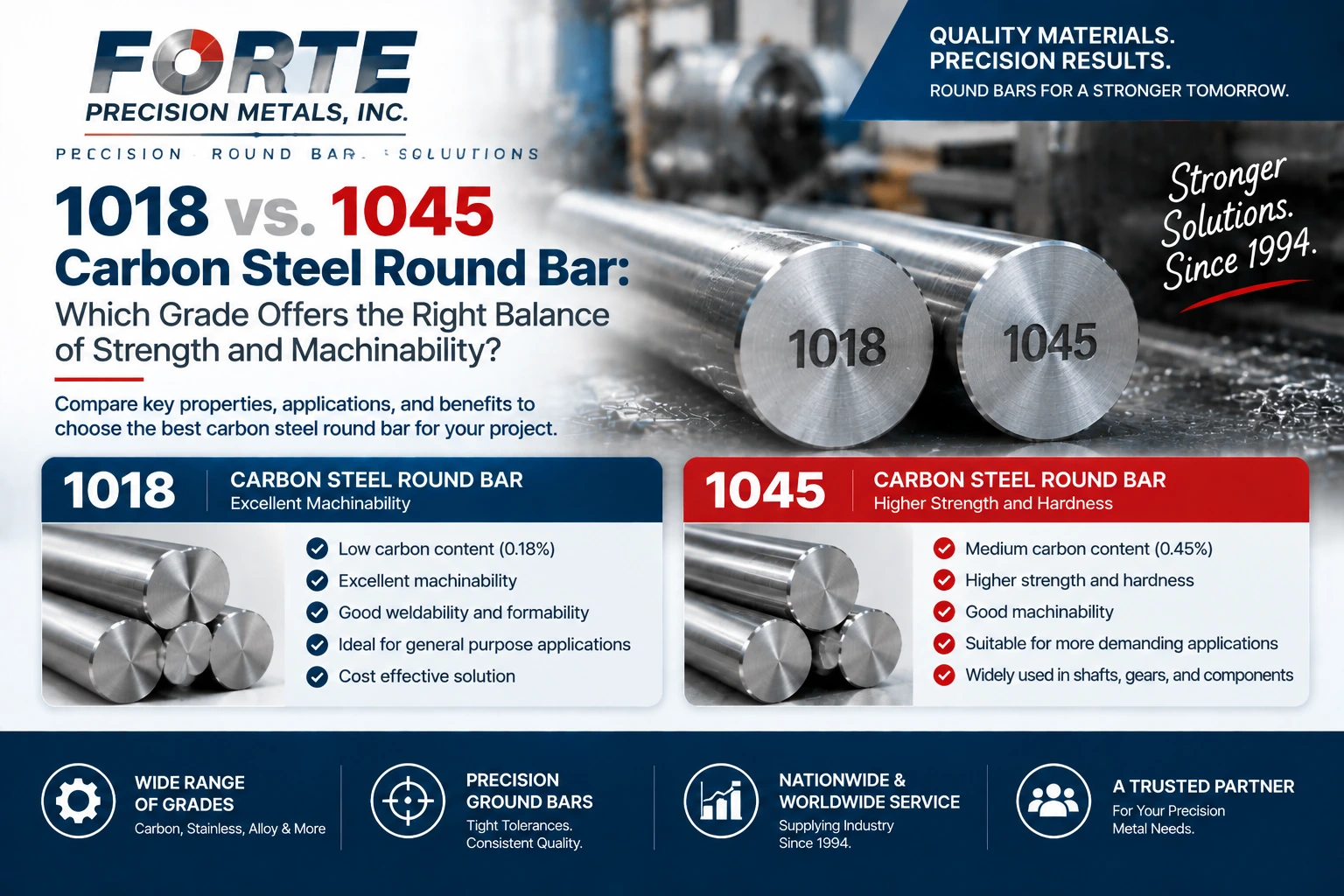
Our 1018 carbon steel page identifies a carbon range of 0.15 to 0.20 percent. That low-carbon composition supports good machinability and weldability. Our 1045 steel page lists 0.42 to 0.50 percent carbon, placing it in the medium-carbon category and giving it a stronger foundation for hardening and higher-load parts.
Why Carbon Level Matters During Selection
More carbon does not simply mean a better bar. The higher carbon level in 1045 can support greater hardness and strength, but it also makes fabrication decisions more sensitive. The lower carbon level in 1018 favors operations in which cutting, welding, bending, or forming efficiency matters more than maximum hardness.
Strength and Ductility Serve Different Priorities
1045 generally provides higher strength than 1018 because of its higher carbon content. Actual mechanical properties depend on bar condition, processing, and specification requirements. The 1045 grade is often the stronger candidate, while 1018 remains attractive where ductility and uncomplicated fabrication carry more weight.
Which Grade Is Easier to Machine and Weld?
Machining and welding can control cost as strongly as raw strength. We therefore separate the question of whether a grade can be processed from whether it is the most efficient choice for the actual production sequence.
1018 Supports Straightforward Fabrication
The low carbon content of 1018 makes it a practical material for turned, threaded, welded, and formed components. It is commonly associated with pins, shafts, gears, fasteners, spindles, and sprocket assemblies. For a high-volume part that does not require the higher strength or hardening response of 1045, 1018 may reduce unnecessary processing complexity.
1045 Requires More Deliberate Process Planning
The 1045 grade can still be machined and welded, but appropriate techniques matter. Its added carbon changes cutting behavior and raises the importance of welding procedure, section size, and condition. We would not select it only because a drawing uses the word steel. We would select it when its strength and hardening potential answer a real service requirement.
Machining Allowance and Bar Condition
A buyer should specify whether the requirement is hot rolled, cold finished, or precision ground. Bar condition affects surface quality, dimensional consistency, stock allowance, and the amount of material that must be removed. A precise starting diameter can be valuable for turning operations, but the allowance must still support cleanup across the full finished part.
Where Each Carbon Steel Grade Fits
Applications are useful selection signals when they are treated as examples rather than automatic approvals. The load, geometry, heat treatment, environment, and governing specification remain more important than the part name by itself.
Typical Uses for 1018 Round Bar
We commonly discuss 1018 for pins, rods, shafts, gears, ratchets, tool holders, fasteners, anchor bolts, spindles, and structural parts. These uses reflect its balance of availability, machinability, weldability, and cost. A lightly loaded shaft may benefit from that balance, while a highly stressed shaft may direct the engineer toward another grade.
Typical Uses for 1045 Round Bar
Our product page identifies axles, bolts, connecting rods, crankshafts, gears, and rods among common uses for 1045. These parts often need more strength or wear capability than a low-carbon grade supplies. However, the required heat treatment and final hardness must be stated rather than assumed from the grade name.
How to Specify the Right Round Bar
A useful RFQ connects material identity with dimensional and processing requirements. This prevents a technically correct grade from arriving in a form that creates avoidable work on the shop floor.
Information We Need for an Accurate Quote
Include the grade, bar condition, diameter, length, quantity, dimensional tolerance, straightness requirement, surface-finish requirement, and any applicable material specification. Add the finished-part application and required documentation when those details affect supply. Our broader carbon steel round bar selection can help frame alternatives, but the final requirement should stay tied to the drawing.
Our Practical Selection Summary
Choose 1018 when machinability, weldability, forming, and general-purpose performance lead the decision. Choose 1045 when higher strength, wear needs, or hardening response justify the added processing considerations. If the print leaves the condition or finish unclear, we can review the requirement before material is released for production.
Request Carbon Steel Round Bar to Match Your Print
At Forte Precision Metals, we can help align carbon steel grade selection with bar size and processing requirements. Send the drawing, quantity, grade, condition, tolerance, finish, and length through our Request a Quote page so we can review the correct starting material for your job.
Frequently Asked Questions
Is 1045 always stronger than 1018?
1045 generally offers greater strength and hardening potential because it contains more carbon. Actual strength depends on bar condition and heat treatment, so the specification should identify the required state rather than relying only on the grade.
Which grade is easier to weld?
1018 is normally the more forgiving welding choice because of its lower carbon content. Welding 1045 calls for greater attention to section size, procedure, and heat control.
Can 1018 be hardened?
Its low carbon content limits conventional through-hardening response. Surface-hardening methods may be considered for some designs, but the drawing and process specification should define the required result.
Is 1045 suitable for shafts and gears?
Yes, shafts and gears are common 1045 applications. Suitability still depends on load, geometry, hardness, fatigue requirements, and final processing.
Should the RFQ identify cold-finished or precision-ground bar?
Yes. The starting condition affects diameter consistency, surface finish, straightness, and machining allowance. State the needed condition and measurable requirements in the RFQ.
Can Forte Precision Metals help confirm availability?
Yes. Provide the grade, diameter, length, quantity, condition, tolerance, and finish through the quote form so we can review the current requirement.