The first titanium question we ask isn’t “which grade?” It’s what the part has to do. Does it need to be as strong as possible? Formable? Weldable? Is it headed into an aircraft assembly or a medical device? Those answers usually narrow a titanium grade list faster than any spec sheet.
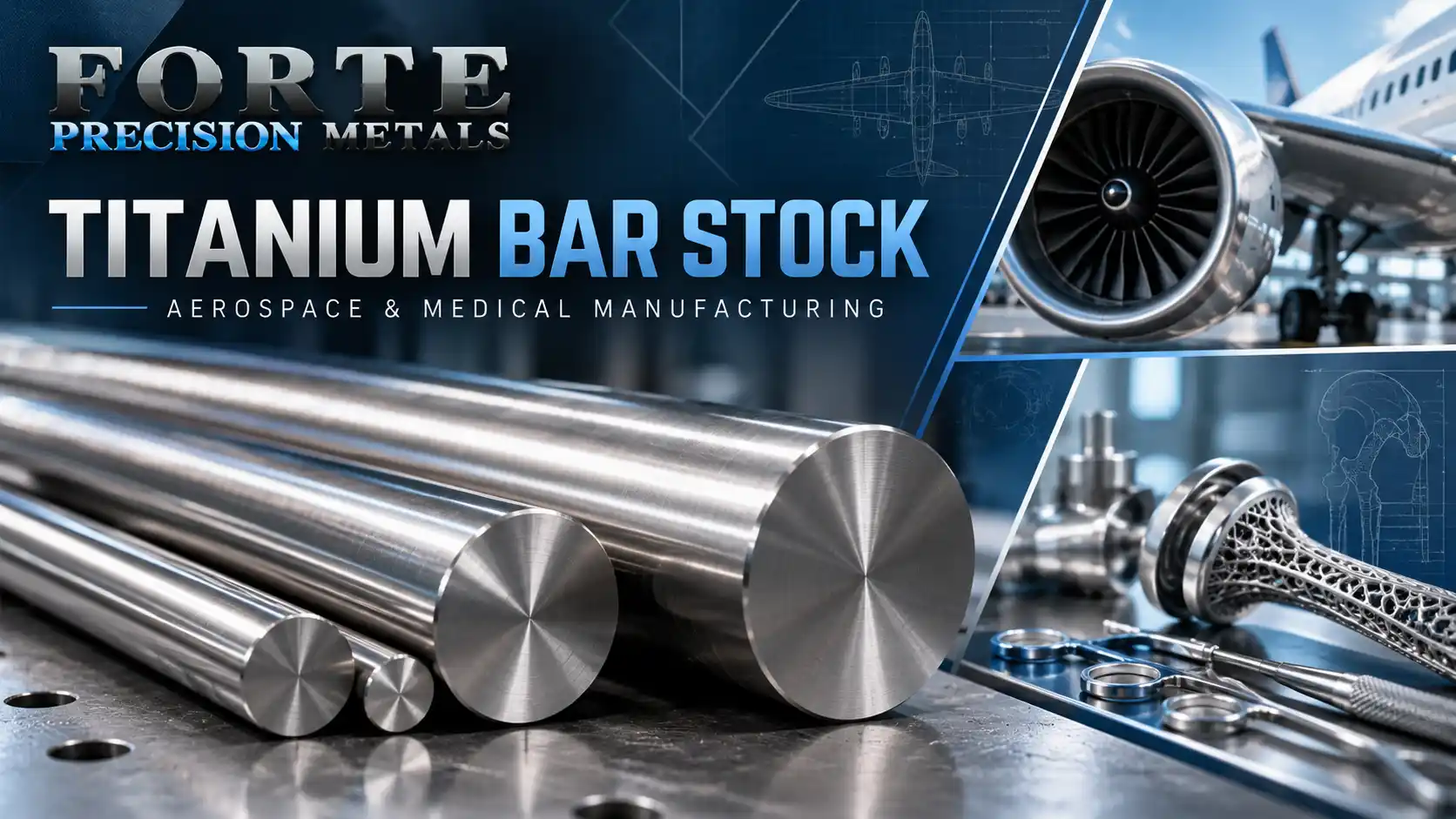
We’re Forte Precision Metals, Inc. in Chicago, IL, and titanium is one of the nine material families we stock. Titanium combines lightweight properties, corrosion resistance, and a high strength to density ratio, making it useful in aerospace, medical, military, and automotive applications. Below, we’ll explain how different titanium grades compare for aerospace and medical manufacturing requirements.
Working Through a Titanium Grade Choice
Grade 5 tends to get most of the attention, and we’ve covered it on its own in our post on Grade 5 titanium for aerospace structural components. Other titanium grades are also worth considering, especially if you manufacture components for both aerospace and medical applications.
Commercially Pure Grades and the Rest of the List
Titanium Grades 1 through 4 are commercially pure (CP) grades, with different strength and ductility characteristics. Grade 1 is the softest and offers the highest ductility among these grades. Grade 2 provides moderate strength and good weldability, while Grade 3 offers greater strength and excellent corrosion resistance. Grade 4 is also commercially pure and corrosion resistant.
Beyond the commercially pure grades, Grades 5, 6, 7, 9, 12, and 23 each have their own characteristics. Comparing these differences helps narrow the options for specific component requirements.
Titanium Grades for Aerospace Applications
Seven titanium grades have aerospace applications. Grade 2 offers moderate strength and good welding, Grade 3 is stronger with excellent corrosion resistance, and Grade 4 is commercially pure and corrosion resistant. Grade 5 is the strongest commercially available grade. Grade 6 offers good strength and weldability and is used only in aerospace. Grade 9 has medium strength and excellent corrosion resistance, and Grade 23 offers better fracture toughness and lower oxygen.
That’s a wide range of properties under one industry label. A welded aerospace bracket and a highly loaded structural component may point to very different grades.
Titanium Grades for Medical Applications
Five grades have medical applications: Grade 1, the softest grade with the highest ductility, along with Grades 4, 5, 9, and 23 from the aerospace group above.
For medical buyers, those descriptions are a starting point. Your device requirements, and any standards your quality team works to, should drive the final choice.
Where Aerospace and Medical Overlap
Grades 4, 5, 9, and 23 have applications in both aerospace and medical manufacturing. That overlap can be useful when comparing material requirements across projects, but the grade alone does not establish suitability. Each component must meet its applicable material specifications and documentation requirements before a common grade is selected.
Grade 23 is a useful example. Its applications are aerospace and medical only, so it’s worth a look if you manufacture components for both industries. Your required material specifications will confirm whether it fits.
Ranking the Property That Matters Most
Once you’ve identified potential grades, compare them against the most important requirement of your component. For formability, Grade 1 offers the highest ductility. For strength, Grade 5 is the strongest commercially available grade. For welding, Grade 2 offers good weldability, while Grade 6 combines strength and weldability. Grades 3 and 9 both offer excellent corrosion resistance, and Grade 23 offers better fracture toughness.
It helps to rank which of these matters most for the part before comparing grades. The grade that leads in one area isn’t necessarily the right pick if a different property drives the design.
Grades Listed for Other Industries
Some titanium grades serve applications outside aerospace and medical manufacturing. Grade 7 offers excellent welding and is used in chemical processing and power generation applications. Grade 12 provides enhanced corrosion resistance for industrial and power generation environments.
Titanium Stock or Ground Bar
We supply titanium stock and titanium ground bar stock. If you need ground bar, confirm with us whether your grade and size fit our in house centerless grinding range of up to 7″ in diameter and 24 feet in length.
Precision metal cutting on CNC enabled saws handles cut to length jobs, in singles or bundles, and we ship nationally and worldwide.
Quality and Documentation
We’re an ISO 9001:2015 certified round bar supplier. Our quality system includes Advanced Quality Planning, Statistical Process Control, Gauge R&R, and Machine Capability Studies. Aerospace and medical programs often carry documentation requirements of their own. Tell us yours at the quote stage, so we can confirm what we can provide before the order is placed.
Details to Include in a Titanium Request
A useful titanium request names the grade you’re considering or the property that matters most, the industry and the part, and the diameter and length with any tolerance or finish callouts. Tell us whether you need ground bar or standard stock, along with your packaging and shipping details. These details give us a starting point for discussing the available titanium grades and bar forms for your project.
Let’s Talk Through Your Titanium Spec
If you’re choosing titanium bar stock for an aerospace or medical part, call us at +1 (847) 451-8888, Monday through Saturday, 7 AM to 5 PM. You can also send your drawing through our request a quote page. Tell us what the part needs to do, and we’ll work through the grade options with you.
FAQs
Which titanium grades are used in both aerospace and medical manufacturing?
Titanium Grades 4, 5, 9, and 23 have applications in both aerospace and medical manufacturing.
Which titanium grade is the strongest?
Grade 5 is the strongest commercially available grade, used in marine, aerospace, and medical applications.
Which titanium grades offer good weldability?
Grade 2 offers good weldability, and Grade 6 combines strength and weldability. Grade 7 offers excellent welding, with applications in chemical processing and power generation.
Do you offer titanium as ground bar stock?
Yes. We supply titanium ground bar stock as well as titanium stock.