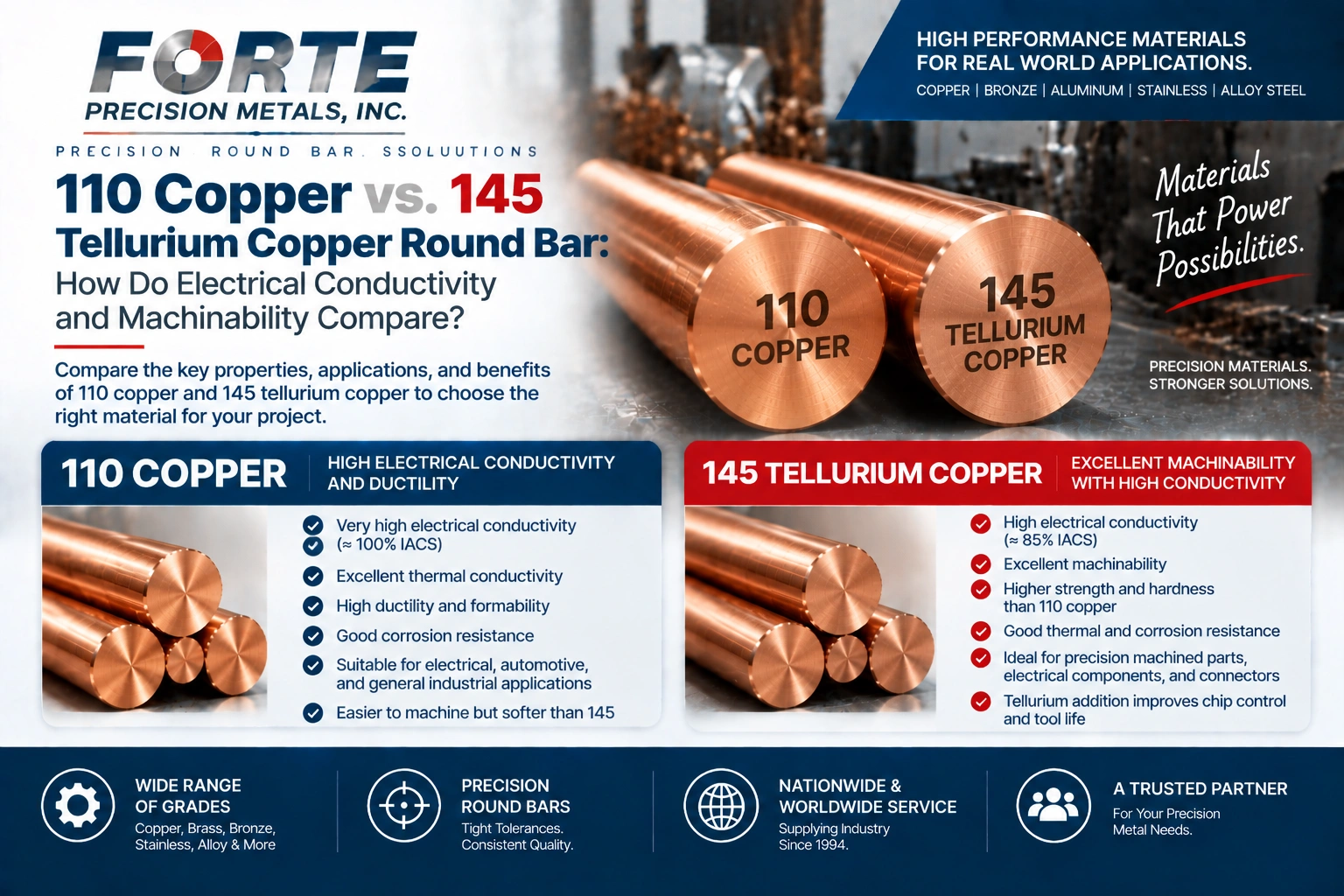
The 110 copper vs. 145 tellurium copper round bar choice balances electrical performance against machining efficiency. We generally consider C110 when the design places maximum emphasis on electrical and thermal conductivity, formability, and conventional copper applications. We consider C145 when the component still needs strong conductivity but also requires turning, drilling, threading, or repeated precision-machining operations.
At Forte Precision Metals, we supply copper round bar and support precision size and processing requirements. The correct grade depends on the finished part, not simply on a request for copper. Chemistry, temper, diameter, finish, joining method, current load, and machining route should all appear in the purchasing conversation.
What Changes Between C110 and C145 Copper?
C110 is electrolytic tough-pitch copper with very high copper content. C145 introduces a controlled tellurium addition to improve chip formation and machinability while retaining useful electrical and thermal performance.
C110 Prioritizes Conductivity and Formability
110 copper contains approximately 99.9 percent copper with oxygen at 0.05 percent maximum. This grade provides excellent electrical and thermal conductivity, corrosion resistance, formability, and hot and cold workability. Common uses include motors, bus bars, electromagnets, wiring, electronics, plumbing hardware, decorative hardware, and telecommunications.
Where High Conductivity Controls the Design
Bus bars, current-carrying connectors, grounding components, and thermal parts may place conductivity ahead of machining speed. In those cases, C110 can be the more direct choice. Cross-sectional area, temperature rise, joint design, surface condition, and current density still need to be evaluated by the engineer.
C145 Adds Tellurium for Machinability
145 tellurium copper contains approximately 99.5 percent copper and 0.5 percent tellurium. The alloy has a machinability rating of 85, which supports improved chip control compared with pure copper grades. Common uses includes electrical switches, contacts, connectors, fasteners, motor parts, pins, soldering coppers, clamps, and plumbing fittings.
How Electrical Conductivity Compares
Both grades remain copper-rich and both are relevant to electrical components. The difference is whether the application needs conductivity as close as practical to the C110 baseline or can trade some conductivity for substantially better machining behavior.
C110 for Conductivity-First Components
C110 is widely selected when electrical or thermal transfer is the dominant function. The very high copper content supports that role. If the part geometry is simple, formed, stamped, or only lightly machined, there may be little reason to introduce a machinability-focused alloy.
C145 for Machined Electrical Components
C145 is valuable when an electrical component includes threads, shoulders, grooves, flats, or other features that must be produced efficiently. It retains strong electrical conductivity while tellurium improves chip control. The engineer should verify that its conductivity satisfies the electrical calculation rather than assuming all copper grades perform identically.
Conductivity Must Be Evaluated in the Finished Connection
Alloy conductivity is only one part of connection performance. Contact area, surface oxides, plating, joint pressure, temperature, geometry, and assembly method can influence resistance. Material selection should therefore support the complete electrical design, not replace it.
Machining, Forming, and Joining Differences
Production method can decide which grade creates the better total result. A conductivity-first material may require more care in machining, while a free-machining copper can simplify a complex turned part.
Machining C110
C110 is ductile and can produce long, stringy chips during turning or drilling. Rigid setups, sharp tools, suitable geometry, and controlled cutting conditions help manage the material. It can still be machined successfully, especially for simple parts, but it is not selected primarily for free-cutting behavior.
Machining C145
Tellurium promotes chip breaking, which is why C145 is often called tellurium copper. The machinability rating of 85 supports its use for connectors, pins, fasteners, and other precision machined electrical components. Better chip control can be particularly relevant for repeated turning and drilling operations.
Forming and Joining
Our C110 copper provides strong hot and cold workability and significant soldering capability. C145 tellurium copper can be brazed or soldered readily, while several welding methods may require additional consideration. The exact temper, geometry, and joining process should be specified before manufacturing begins.
Applications That Clarify the Selection
Application examples help identify the dominant attribute, but they do not replace the electrical, mechanical, thermal, or fabrication requirements on the drawing.
When We Would Start with C110
We would start with C110 for bus bars, electromagnets, wiring-related hardware, thermal components, and parts where conductivity and forming are more important than complex machining. We would then confirm temper, size, finish, joining, and any plating requirement.
When We Would Start with C145
We would start with C145 for turned contacts, threaded connectors, pins, clamps, fasteners, switch components, and motor parts that require meaningful stock removal. The material can offer a practical balance between copper performance and machining productivity.
How to Specify Copper Round Bar
State the UNS or alloy designation, temper or condition, diameter, length, quantity, dimensional tolerance, straightness, surface finish, conductivity requirement, joining method, plating requirement, documentation, and application. Our copper round bar category provides the parent context, while the purchase specification should identify the exact grade.
Our Selection Summary
Choose C110 when electrical or thermal conductivity and formability dominate. Choose C145 when the part must retain strong conductivity while supporting efficient precision machining. If the component is both heavily loaded electrically and geometrically complex, verify conductivity and production requirements together before approving the grade.
Request Copper Round Bar for Your Drawing
At Forte Precision Metals, we can review grade, temper, diameter, length, tolerance, finish, quantity, and processing requirements. Submit the complete information through our Request a Quote page so we can evaluate the correct copper round bar for your application.
Frequently Asked Questions
These questions address the most common differences buyers need to confirm.
Which grade offers better electrical conductivity?
C110 is the conductivity-first choice in this comparison. C145 retains strong conductivity but includes tellurium to improve machinability.
Which copper grade is easier to machine?
C145 is easier to machine because tellurium improves chip breaking. We list its machinability rating as 85.
Can C145 replace C110 in a bus bar?
Only after electrical and engineering review. The required conductivity, temperature rise, joint design, geometry, and specification must approve the substitution.
Is C110 suitable for machined parts?
Yes, particularly for simpler geometry. It usually requires more deliberate chip control than C145 during extensive turning or drilling.
Can both grades be soldered or brazed?
Both grades support soldering and brazing applications. The exact process, filler, temper, geometry, and acceptance criteria should be defined before production.
What should a copper-bar RFQ include?
Include grade, temper, diameter, length, quantity, tolerance, straightness, finish, conductivity requirement, joining or plating needs, and required documentation.