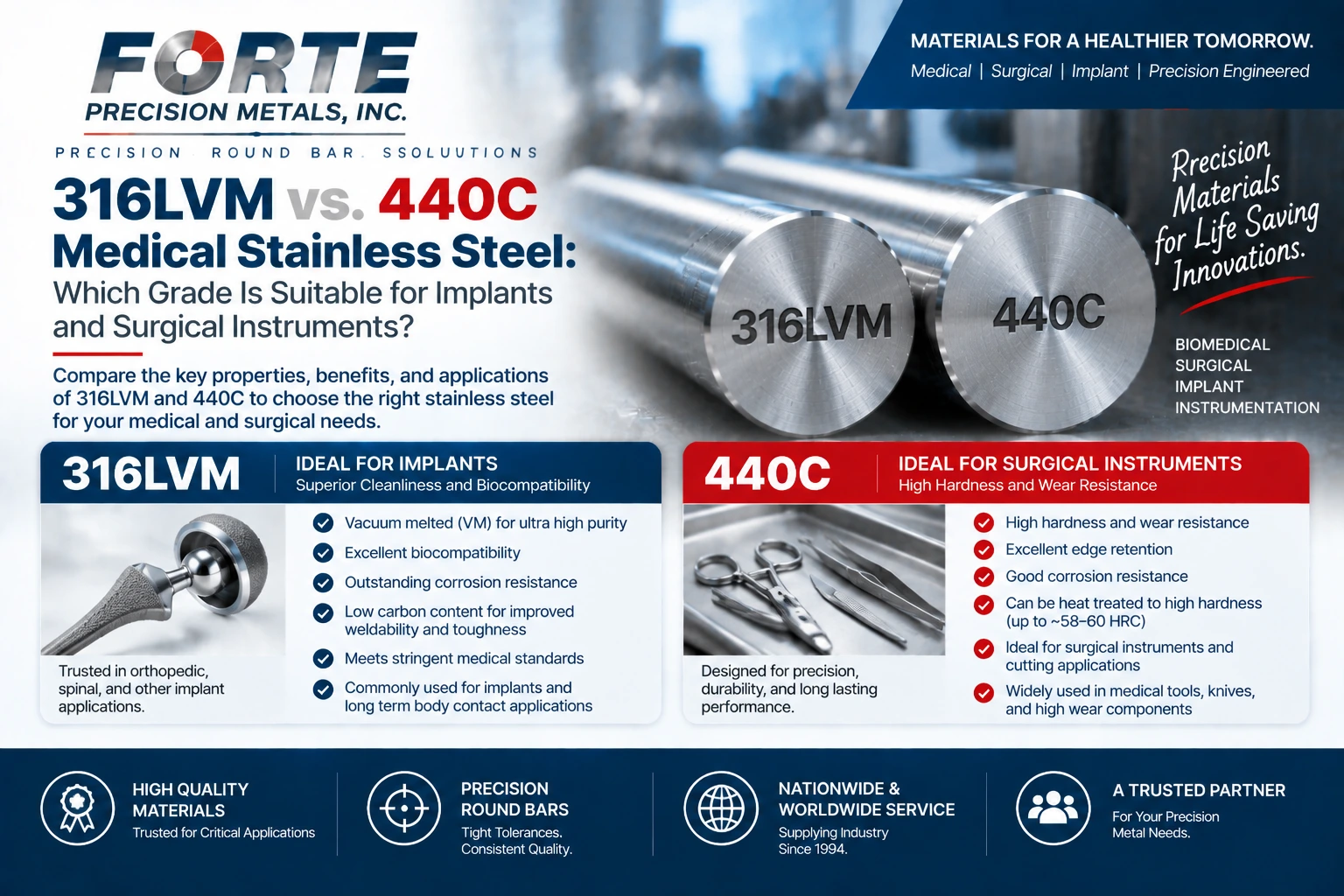
The 316LVM vs. 440C medical stainless steel decision is not a simple comparison of two stainless grades. We generally associate 316LVM with high cleanliness, corrosion resistance, and specified implant or medical-device applications. We associate 440C with high hardness, edge retention, wear resistance, bearings, and cutting or surgical instruments. The finished device, governing specification, heat treatment, sterilization exposure, and regulatory requirements must control the selection.
At Forte Precision Metals, we supply stainless steel round bar and help manufacturers define diameter, length, finish, tolerance, and processing requirements. We do not treat the words medical or surgical as universal approval. Buyers must identify the exact grade, specification, condition, documentation, and end-use requirements on the RFQ.
Why 316LVM and 440C Serve Different Medical Functions
Both grades are stainless steels, but their metallurgy points them toward different jobs. 316LVM is a low-carbon, vacuum-melted austenitic grade. 440C is a high-carbon martensitic grade designed to develop substantial hardness through heat treatment.
316LVM Emphasizes Cleanliness and Corrosion Resistance
Our 316LVM stainless steel page describes a low-carbon vacuum-melted material produced for high purity and cleanliness. It lists chromium at 17 to 19 percent, nickel at 13 to 15 percent, and molybdenum at 2 to 3 percent. The page also identifies resistance to pitting and crevice corrosion and use in medical devices.
What Vacuum Melting Changes in the Selection Context
Vacuum melting is relevant because medical specifications may control cleanliness and inclusion content more closely than general industrial stainless requirements. It does not remove the need for specification review. The buyer should name the required standard, melt practice, condition, certification, and testing rather than requesting generic 316 stainless.
440C Emphasizes Hardness and Wear Performance
Our 440C stainless steel contains approximately 1.0 to 1.2 percent carbon and 16 to 18 percent chromium. This high carbon and chromium composition supports hardness, mechanical strength, and wear resistance. Common applications include knife blades, ball bearings, and roller bearings. Surgical equipment may use 440C where hardness and cutting performance are required.
Implants and Instruments Create Different Priorities
A material suitable for a cutting edge is not automatically suitable for long-term implantation. The service environment and device function establish the attributes that deserve the most weight.
Why 316LVM Is Considered for Implant Applications
316LVM is commonly considered when corrosion behavior, cleanliness, ductility, and austenitic structure are central. We connect it with implants and surgical instruments, but a device manufacturer must still verify the required medical specification and intended duration of contact. Material identity alone does not establish regulatory acceptance or biocompatibility for a finished device.
Why 440C Fits Cutting and Bearing Components
440C can be hardened to support sharp edges, wear surfaces, and rolling contact. Those attributes make it relevant to cutting tools, instrument components, and bearings. Its corrosion resistance is more moderate than that of lower-carbon austenitic grades, so cleaning agents, sterilization cycles, surface condition, and maintenance must be evaluated for the actual instrument.
Hardness Must Be Tied to Heat Treatment
A request for 440C should state the supplied condition and any final hardness requirement. Over-tempering and other heat-treatment choices can affect corrosion behavior as well as hardness. The drawing should also define whether machining occurs before or after hardening and how final dimensions will be restored.
Corrosion, Magnetism, and Sterilization Considerations
Medical environments combine moisture, salts, cleaning chemicals, repeated sterilization, and close dimensional requirements. Each of these conditions may change the material decision.
Corrosion Resistance Is Not a Single Rating
316LVM is positioned for stronger pitting and crevice-corrosion resistance, supported by its chromium, nickel, and molybdenum content. 440C trades some corrosion performance for higher carbon and hardenability. Surface finish, passivation, crevices, residues, and sterilization chemistry can alter real performance, so the service environment should be described in the material review.
Magnetic Behavior Can Affect Device Design
The grade remains nonmagnetic even after extensive cold forming. 440C is martensitic and is magnetic. If magnetic response affects imaging, sensors, handling, or device function, the engineering requirement should be explicit rather than inferred from the stainless label.
Machining and Precision Round-Bar Requirements
Both grades require a processing plan that respects their metallurgical differences. Starting bar condition can influence tool choice, stock allowance, distortion risk, and final surface preparation.
Processing 316LVM
Austenitic stainless steels can work harden during machining, making rigid setups, appropriate tooling, and controlled cutting conditions important. A consistent starting diameter and suitable surface finish can help downstream planning. Buyers should state whether the bar must be cold finished or precision ground and identify any controlled straightness or finish requirement.
Processing 440C
440C may be machined in an annealed condition and then hardened, depending on the component route. Heat treatment can create dimensional changes that require finishing allowance. For cutting or bearing parts, final hardness, surface finish, geometry, and inspection may matter as much as the initial bar grade.
How to Prepare a Medical Stainless Steel RFQ
Include the exact grade, governing material specification, melt requirement, condition, diameter, length, quantity, tolerance, straightness, surface finish, heat treatment, documentation, and testing. Medical stainless steel specifications provide material context, while the device drawing must define the acceptance requirements.
Our Selection Summary
Choose 316LVM when the verified device specification prioritizes vacuum-melt cleanliness, corrosion resistance, ductility, and implant or medical-device use. Choose 440C when hardness, wear resistance, edge performance, or bearing duty leads the design. Never substitute one for the other without engineering and specification approval.
Request Stainless Steel Bar for a Controlled Requirement
At Forte Precision Metals, we can review the bar grade and processing information supplied with your drawing. Submit the exact material specification, condition, diameter, tolerance, finish, quantity, and documentation through our Request a Quote page.
Frequently Asked Questions
Is 316LVM the same as standard 316L?
No. 316LVM identifies a vacuum-melted version with controlled cleanliness requirements. The governing specification must define the exact material needed.
Can 440C be used for surgical instruments?
Yes, it may be used where hardness, wear resistance, or a cutting edge is required. The instrument specification and sterilization environment must confirm suitability.
Is 440C appropriate for implants?
It should not be assumed. Implant selection requires the exact device specification, corrosion evaluation, documentation, and regulatory controls. 316LVM is the more typical candidate in this comparison.
Which grade has better corrosion resistance?
316LVM generally provides stronger corrosion resistance, particularly where pitting and crevice corrosion matter. 440C prioritizes hardness and wear performance.
Which grade is magnetic?
440C is magnetic because of its martensitic structure.
What documentation should the RFQ request?
State the governing specification, certification, heat or lot documentation, testing, condition, and any device-specific quality requirements needed for acceptance.