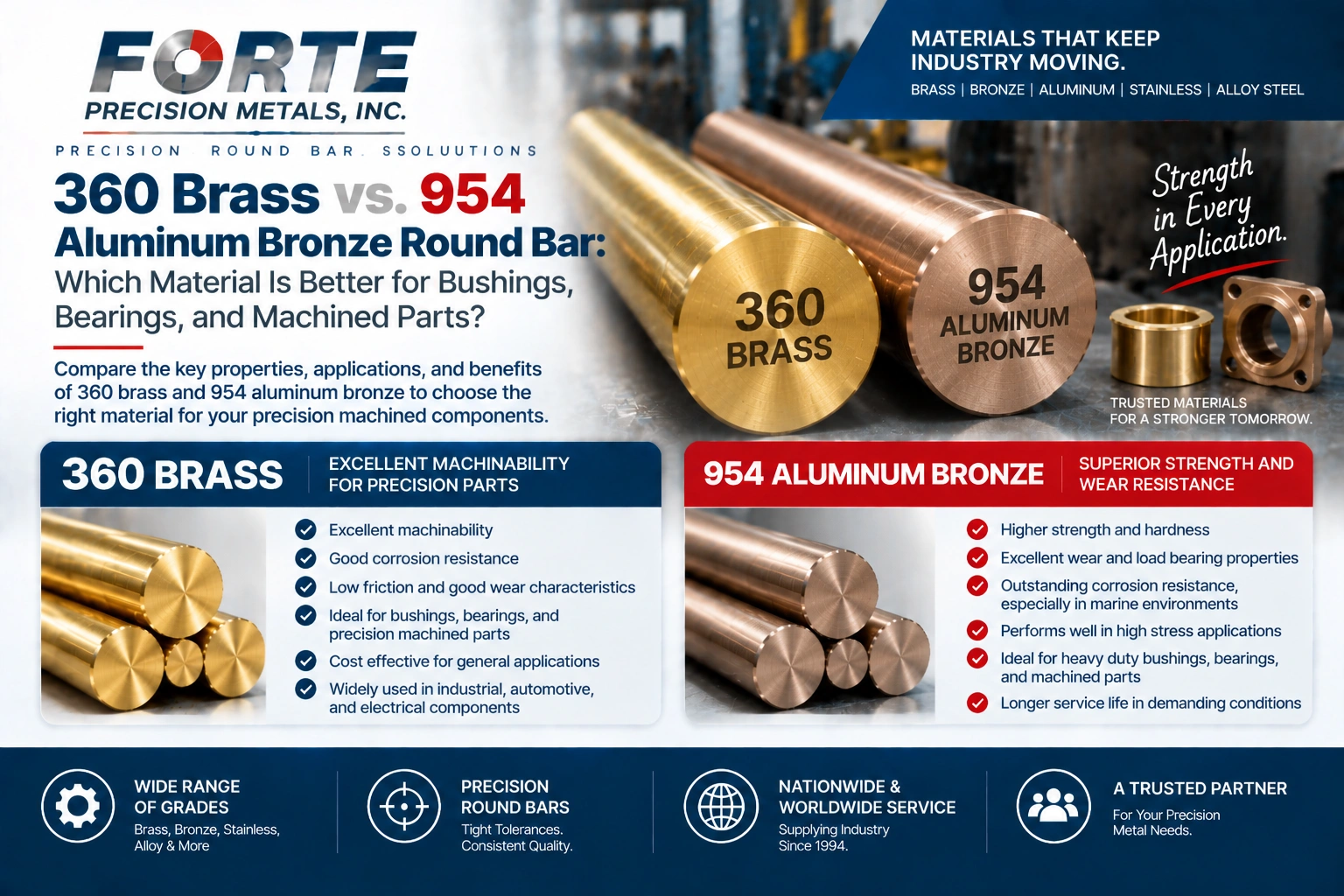
The 360 brass vs. 954 aluminum bronze round bar decision depends on whether machining efficiency or service durability is the stronger requirement. We generally consider 360 brass for high-volume precision-machined fittings, connectors, adapters, nuts, bolts, and valve components. We consider 954 aluminum bronze when bushings, bearings, gears, pumps, valves, or wear surfaces need greater strength, deformation resistance, and corrosion performance.
At Forte Precision Metals, we supply brass and bronze round bar and support related grinding and machining requirements. These alloys should not be treated as interchangeable copper-based materials. Their alloying elements create different chip behavior, mechanical capability, wear response, and environmental fit.
How 360 Brass and 954 Aluminum Bronze Differ
The chemistry establishes the basic manufacturing and service profile. C360 is a copper-zinc-lead brass designed around machinability. C954 is a copper-aluminum-iron bronze designed around strength, wear, and corrosion resistance.
360 Brass Is Built for Machining Productivity
360 brass contains approximately 61.5 percent copper, 35.5 percent zinc, and 3 percent lead. The lead content promotes chip breaking and supports efficient machining performance. This makes it attractive when a shop must turn, drill, thread, or form detailed components efficiently.
Where Free-Cutting Behavior Creates Value
Machining productivity matters when the part includes multiple diameters, threads, cross holes, or repeated features. Clean chip control can support cycle consistency and tool management. The final decision must still consider strength, pressure, temperature, corrosion, and any restrictions on lead-containing alloys.
954 Aluminum Bronze Is Built for Demanding Service
954 aluminum bronze contains approximately 85 percent copper, 11 percent aluminum, and 4 percent iron. This alloy provides strength, corrosion resistance, metal to metal wear resistance, and deformation resistance. Bearings, bushings, pumps, valves, gears, and worms are common applications.
Which Material Is Better for Bushings and Bearings?
Bearing and bushing selection depends on load, speed, lubrication, mating material, temperature, contamination, and allowable wear. The part name alone does not approve an alloy.
Why 954 Bronze Often Leads for Loaded Wear Parts
C954 is usually the stronger candidate when a bushing or bearing carries substantial load or sees metal-to-metal contact. Its resistance to wear and deformation directly addresses those demands. Marine or industrial exposure may also favor it because 954 aluminum bronze is commonly selected for seawater, chloride, dilute acid, valve, and heavy industrial applications where corrosion resistance and wear performance are important.
When 360 Brass Can Still Make Sense
C360 may suit lightly loaded bearing-related hardware, retainers, fittings, or precision components where machinability is more important than severe wear performance. It is not the default substitute for a specified bearing bronze. Engineers should evaluate load and sliding conditions before moving from C954 to free-cutting brass for cost or machining convenience.
Machinability Ratings Are Relative, Not Complete Decisions
C360 has a machinability rating of 100, while C954 has a machinability rating of 60. This comparison indicates that C360 is generally easier to machine, but machinability alone does not determine final alloy selection. A lower machining rating can be acceptable when the finished component gains the service properties it actually needs.
Strength, Wear, and Corrosion Priorities
A material that machines quickly may not carry the required load, while a stronger alloy may be unnecessary for a simple connector. Ranking the dominant attributes prevents over-specification and under-specification.
Mechanical Strength and Deformation
360 brass has an ultimate tensile strength range of approximately 49,000 to 68,000 psi. 954 aluminum bronze has an ultimate tensile strength of approximately 74,700 psi and a yield strength of approximately 29,700 psi. Values depend on form and condition, so buyers should use the controlling specification.
Environmental Exposure
C360 offers useful corrosion resistance for many plumbing, electrical, and general manufacturing applications. C954 is positioned for stronger resistance in seawater, chlorides, and dilute acids. The actual fluid, temperature, galvanic couple, crevice geometry, and maintenance conditions should be reviewed before selection.
Which Alloy Is Better for Precision-Machined Parts?
For detailed parts made in volume, C360 often has the advantage because its chemistry was developed for free machining. For machined parts that also function as loaded bearings, bushings, gears, or valve components, C954 may justify the slower machining response.
Match the Alloy to the Functional Feature
Threads, fine features, and cycle time may point toward C360. Bearing surfaces, impact, heavy load, or marine exposure may point toward C954. A complex assembly can even use different alloys in different components. The print should identify the material by grade instead of using the broad word bronze or brass.
Define the Starting Round Bar
Specify grade, diameter, length, quantity, tolerance, straightness, and surface finish. Our brass, copper, and bronze products provide a parent category for these alloys, while the RFQ should identify whether additional cutting, grinding, turning, or packaging is required.
Our Selection Summary
Choose 360 brass when fast, repeatable machining and detailed part production dominate. Choose 954 aluminum bronze when load, wear, deformation resistance, or demanding corrosion exposure dominates. For bushings and bearings, C954 is usually the more relevant starting point; for general precision-machined hardware, C360 often provides the more efficient route.
Request Brass or Bronze Round Bar
At Forte Precision Metals, we can review the alloy, size, condition, finish, and processing requirements shown on your drawing. Submit the grade, diameter, length, quantity, tolerance, and application through our Request a Quote page.
Frequently Asked Questions
These answers address common sourcing questions for C360 and C954 round bar.
Is 360 brass a bearing bronze?
No. C360 is a free-cutting brass. It may suit some lightly loaded components, but a bearing application should be evaluated against the specified bronze and service conditions.
Why is 954 bronze used for bushings?
Its strength, wear resistance, and resistance to deformation make it relevant to loaded sliding components. Lubrication, load, speed, and mating material remain important.
Which alloy machines faster?
C360 generally machines more efficiently. We list a machinability rating of 100 for C360 and 60 for C954.
Which alloy is better for seawater exposure?
C954 is the stronger candidate in this comparison because its product information specifically identifies seawater and chloride resistance.
Can C360 replace C954 to reduce machining time?
Not without engineering approval. The change may reduce strength, wear performance, and environmental resistance needed by the finished component.
What should the RFQ include?
Include alloy designation, condition, diameter, length, quantity, tolerance, straightness, finish, processing, documentation, and application details.