Choosing between 4130 and 4140 is one of the most common calls we get at Forte Precision Metals. Both are chromium-molybdenum alloy steels, both are heat treatable, and both serve demanding applications across multiple industries. But they behave differently in the shop and in service.
Pick the wrong grade, and you’ll feel it fast. Either the part doesn’t hold up under load, or your shop spends more time machining than planned. Here’s what separates them.
What Really Separates 4130 and 4140 Alloy Steel Round Bar
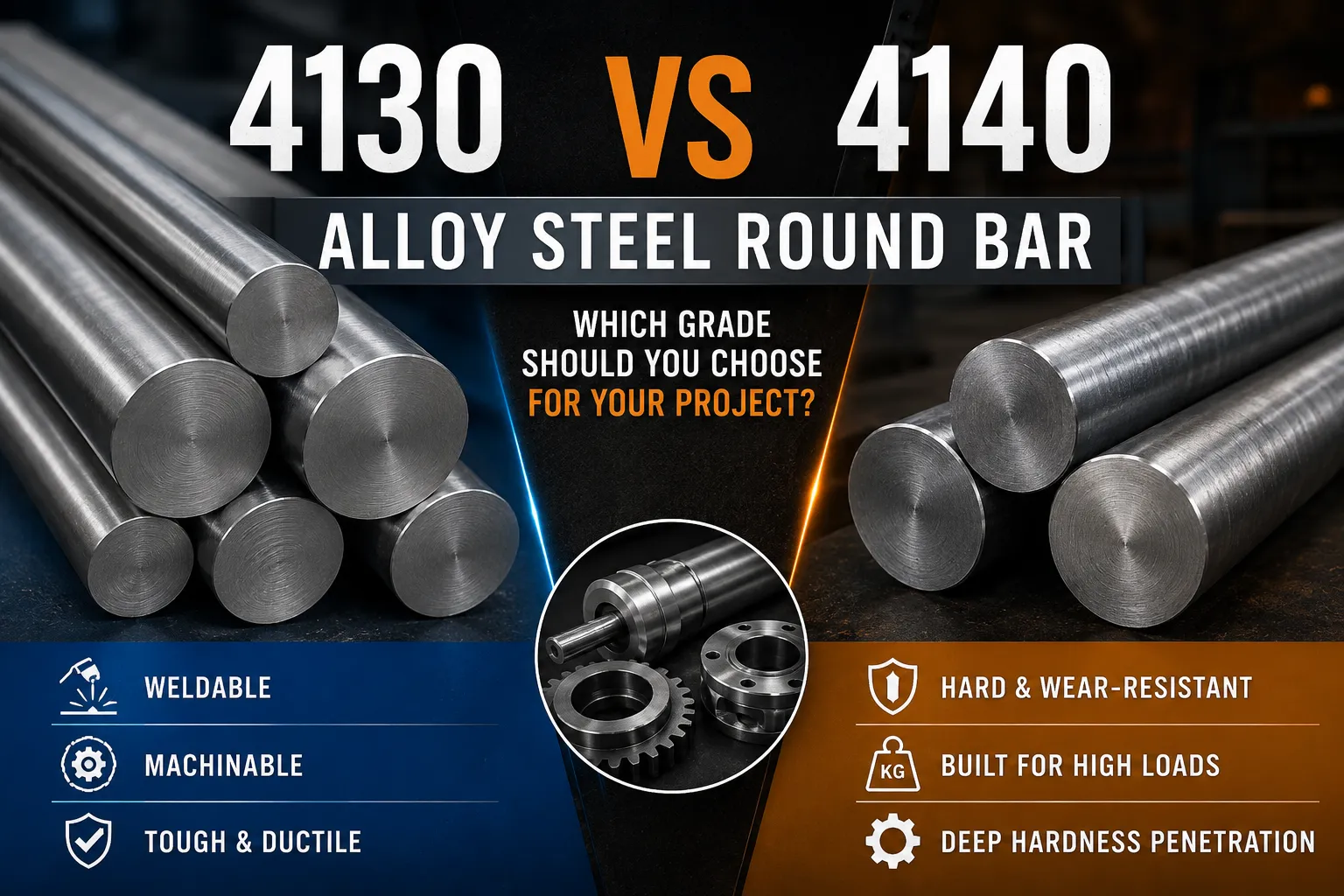
These two grades share a family but serve different purposes. 4130 is built for workability. 4140 is built for toughness under stress. Understanding that distinction is the fastest way to land on the right spec for your project.
Both grades are stocked and precision-ground at our Franklin Park, IL facility. We’ve been processing alloy steel round bar since 1994, so we’ve seen exactly where each grade earns its keep and where the wrong choice creates problems.
4130: Weldable, Machinable, and Easy to Work With
4130 steel is machinable, weldable, and ductile. Those three qualities make it the go-to choice when your part needs secondary operations before or after heat treatment. It cooperates in the weld bay without demanding heavy pre-heat procedures.
Common destinations for 4130 include aircraft structures, automotive frames, and hydraulic tooling. If your application needs consistent toughness and the manufacturing process involves forming or welding, 4130 is where most engineers start.
4140: Hard, Wear-Resistant, and Built for Load
4140 steel is defined by hardness, penetration and wear resistance. When heat-treated, it develops deep, uniform hardness that holds up under sustained load and abrasive conditions. That’s why it appears in highly stressed parts across industrial and oil and gas applications.
The tradeoff is machinability. 4140 machines fine in the annealed condition, but tool wear shows up faster than with 4130. Plan for that difference when estimating cycle times on high-volume runs.
Heat Treatment and Why It Changes the Decision
Both grades respond to heat treatment, but 4140 develops deeper case hardness after the process. If your application carries surface contact stress or has a fatigue requirement, that hardness penetration advantage is exactly what you need.
4130 also strengthens through heat treatment, but its ductility remains its biggest value. It absorbs impact well without cracking, making it the right call when the load is dynamic rather than sustained.
Other Alloy Grades Forte Precision Metals Stocks Beyond These Two
If neither grade fits your spec cleanly, we carry a full alloy steel range. 4142 handles die holders, gears, collets, and axles. 4340 delivers high fatigue strength for aircraft and automotive crankshafts. We also stock ETD 150, 8740, 9310, 41L40, 52100, and Hastelloy C22.
When your project sits outside the standard 41XX family, we have options ready. Our team can help you identify the right grade before you commit to an order.
In-House Processing That Gets Bar Ready for Your Shop
We run centerless grinding up to 7 inches in diameter and up to 24 feet in length at our Franklin Park facility. Bar arrives surface-finished and dimensionally accurate, so your team starts machining immediately without cleanup.
Custom machining handles parts up to 12 inches long, 10 inches in diameter, and 8 feet in length at a tolerance of plus or minus 0.005 inches using CNC and CAD/CAM-equipped operations. Metal turning holds plus or minus 0.001 inches. We also offer bar chamfering, CNC saw cutting for cut-to-length jobs, and rotary bar straightening for ferrous materials.
Quality Standards Behind Every Order
We’ve held ISO 9001:2015 certification since 1994. Our quality systems run Advanced Quality Planning, Statistical Process Control, Gauge R&R, and Machine Capability Studies on every order. That consistency matters when you’re sourcing repeat orders across a production schedule.
Procurement teams working with tight tolerances and traceability requirements rely on that infrastructure. It keeps your receiving process predictable and your production line moving without surprises.
Get a Quote on 4130 or 4140 Alloy Steel Round Bar
The decision between 4130 and 4140 comes down to two questions. Does your part need welding or forming during manufacturing? Start with 4130. Does your application demand hardness and wear resistance under load? 4140 is your grade.
Forte Precision Metals stocks both and grinds both in-house, and has been doing this since 1994. Call us at +1 (847) 451-8888, Monday through Saturday, 7 AM to 5 PM, visit us at 9234 Parklane Ave, Franklin Park, IL 60131, or submit your requirements at fortemetals.com/request-a-quote.
FAQs
Q: Can I substitute 4130 for 4140 in a structural application?
Not without engineering review. They differ in hardness, penetration and weldability. Confirm load requirements and heat treatment specs before switching grades.
Q: Do you stock both grades as precision-ground round bar?
Yes. Both are stocked and ground in-house at Franklin Park, IL, up to 7 inches in diameter and 24 feet in length.
Q: What other alloy steel grades do you carry?
We stock 4142, 4340, 41L40, 52100, 8740, 9310, ETD 150, and Hastelloy C22. Visit our alloy steel round bar page for the full list.
Q: What machining services are available for alloy steel bars?
Forte Precision Metals offers centerless grinding, custom machining, metal turning, milling, saw cutting, bar chamfering, and bar straightening, all completed in-house at our Franklin Park facility.