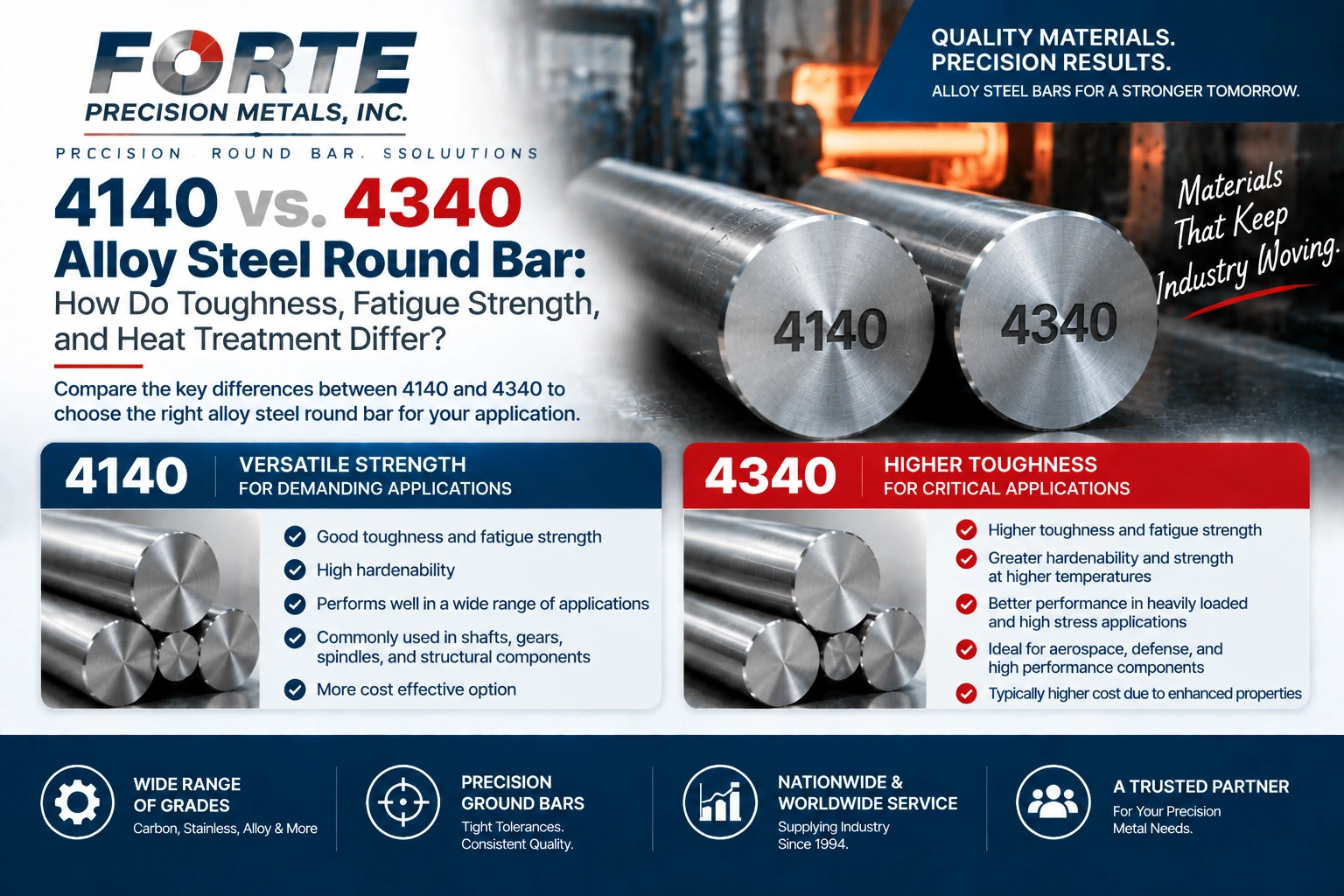
The 4140 vs. 4340 alloy steel round bar comparison becomes important when a component must carry high loads, resist repeated stress, or retain toughness after heat treatment. We commonly view 4140 as a versatile chromium-molybdenum grade for shafts, bolts, gears, pins, and general high-strength parts. We look to 4340 when nickel-enhanced toughness, deeper hardenability, and demanding fatigue performance are more prominent.
At Forte Precision Metals, we help buyers connect alloy selection with round-bar condition, diameter, finish, and downstream processing. The grade name starts the conversation, but section size, heat treatment, hardness, fatigue duty, and machining sequence determine whether the selection will work in production.
What Separates 4140 from 4340 Alloy Steel?
Both grades contain chromium and molybdenum, and both can respond well to heat treatment. The defining compositional difference is the nickel content of 4340, which supports toughness and hardenability in demanding sections.
4140 Is a Chromium-Molybdenum Workhorse
Our 4140 steel page lists 0.38 to 0.43 percent carbon, 0.80 to 1.10 percent chromium, and 0.15 to 0.25 percent molybdenum. This combination makes 4140 useful for axles, shafts, bolts, gears, piston rods, conveyor pins, rolls, spindles, and other components that need strength with practical manufacturing versatility.
Why Molybdenum and Chromium Matter
Chromium and molybdenum help the steel respond to heat treatment and support strength and wear performance. Those benefits still depend on the specified condition. A buyer should not assume that every 4140 bar arrives with the same hardness or mechanical properties.
4340 Adds Nickel for Toughness
Our 4340 round bar page lists 1.65 to 2.0 percent nickel along with chromium and molybdenum. It also identifies strong fatigue resistance and a combination of strength and toughness for components exposed to high stress and impact. Common examples include aircraft parts, automotive systems, hydraulic components, crankshafts, gears, and axles.
How Toughness and Fatigue Requirements Change the Choice
A static strength number does not describe every service condition. Repeated loading, stress concentrations, impact, part size, surface condition, and heat treatment can control whether a component survives its intended duty.
When 4140 Provides the Necessary Balance
4140 often provides an effective balance when a part needs good strength, toughness, and wear performance without the deeper hardenability associated with 4340. It is widely considered for machinery shafts, pins, gears, bolts, and hydraulic components. Its broad use can make it a practical starting point when the design requirements do not justify a more highly alloyed grade.
When 4340 Becomes the Stronger Candidate
4340 becomes more attractive as section thickness, shock loading, cyclic stress, or required toughness increases. Nickel helps it retain toughness while chromium and molybdenum support hardenability. That does not make 4340 an automatic upgrade. If 4140 already satisfies the design, using 4340 may add material and processing considerations without improving the finished part.
Fatigue Performance Depends on More Than Chemistry
Surface finish, diameter transitions, keyways, threads, residual stress, heat-treatment quality, and straightness can all influence fatigue behavior. The grade provides a material foundation, while the final geometry and manufacturing control determine how that foundation performs under repeated loading.
Heat Treatment and Section Size Must Be Specified
Both grades are commonly selected for their heat-treatment response. The RFQ should identify the required supplied condition and final hardness instead of asking for alloy steel with no condition attached.
4140 Heat-Treatment Planning
4140 can be supplied and processed in different conditions, and those conditions change machinability and mechanical behavior. Machining in a softer state followed by heat treatment may suit one component, while purchasing prehardened material may suit another. The sequence must account for dimensional change, cleanup allowance, and final finishing.
4340 Hardenability for Demanding Sections
The alloy system in 4340 supports hardenability through larger sections compared with less highly alloyed steels. This can matter for substantial shafts, gears, or highly loaded components. The heat treater and engineer should define hardness, strength, toughness, testing, and acceptance requirements for the actual section.
Machining and Round-Bar Preparation
Material selection should anticipate what happens before and after turning. A bar that matches the required diameter, straightness, and finish can support a more controlled machining plan.
Machinability Is Condition-Dependent
4140 machinability depends on the supplied condition, hardness, tooling, speeds, feeds, and machining requirements. Identifying the material condition helps manufacturers plan the process effectively. 4340 is also machinable, but its strength and supplied condition influence tooling, speeds, feeds, and stock removal. We recommend identifying condition and hardness on the RFQ so machinability is not discussed in isolation.
Precision Ground Bar Can Support Downstream Control
Our alloy steel round bar offering can be paired with precision-ground requirements when the print calls for controlled diameter and surface condition. Buyers should state tolerance, straightness, length, finish, and machining allowance rather than relying on the word precision alone.
How We Summarize the Selection
Choose 4140 for a versatile high-strength alloy when the required toughness, wear performance, heat-treatment response, and section size fit its capability. Choose 4340 when enhanced toughness, fatigue resistance, impact loading, or hardenability across a demanding section drives the design. Validate the decision against the drawing and required material condition.
Request Alloy Steel Round Bar for Your Application
At Forte Precision Metals, we can review grade, condition, diameter, length, quantity, tolerance, straightness, finish, and processing requirements. Use our Request a Quote form and include the drawing or complete specifications for the 4140 or 4340 bar you need.
Frequently Asked Questions
Is 4340 always stronger than 4140?
Not in every supplied condition. 4340 offers greater alloy content and hardenability, but actual strength depends on heat treatment, hardness, section size, and product condition.
Which grade offers better toughness?
4340 is generally selected when higher toughness is required, particularly in highly stressed or impact-loaded parts. The required toughness should still be defined and verified.
Can both grades be heat treated?
Yes. Both respond to heat treatment. The specified process, section size, target hardness, and testing requirements determine the resulting properties.
Which grade is easier to machine?
Machinability depends strongly on condition and hardness. 4140 is often the more straightforward general-purpose option, while 4340 may require more deliberate machining control in higher-strength conditions.
Are 4140 and 4340 suitable for shafts?
Both are used for shafts. Load, diameter, fatigue duty, impact, heat treatment, straightness, surface finish, and applicable specifications decide which is appropriate.
What should an alloy steel RFQ include?
Include grade, condition, diameter, length, quantity, tolerance, straightness, finish, hardness, testing, certification, and any required processing.