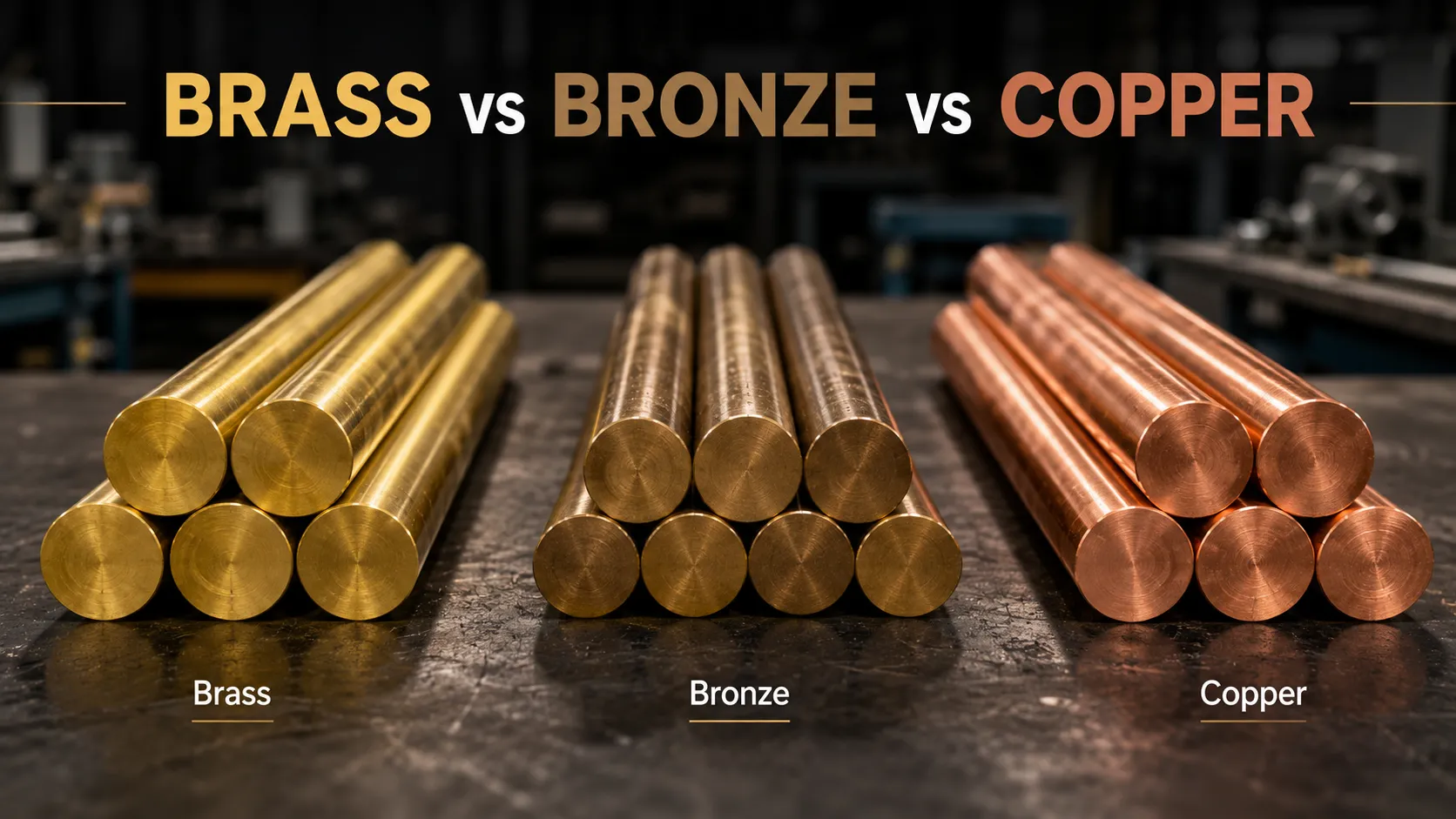
The brass vs bronze vs copper round bar comparison shows that each material family serves a different engineering priority. Copper round bar provides the highest electrical and thermal conductivity, while bearing bronze typically offers better controlled sliding and wear performance. Corrosion resistance varies by the exact alloy and service environment. Brass round bar often provides the most practical balance of machinability, moderate conductivity, general corrosion resistance, and manufacturing efficiency. Forte Precision Metals supplies these copper-based material families in round-bar form.
Why Does Alloy Composition Change Round Bar Performance?
Copper is the base metal in all three families. Commercially pure copper contains little alloying material. Brass is primarily copper and zinc, while bronze may contain tin, aluminum, silicon, manganese, or other additions.
Alloying normally reduces conductivity, but it can increase strength, hardness, wear resistance, machinability, or resistance to a specific corrosion mechanism. A drawing should therefore identify the exact UNS grade and condition rather than only “brass” or “bronze.” Forte’s brass, copper, and bronze product range shows the relevant families and processing scope.
Which Material Conducts Electricity and Heat Best?
Copper is the clear conductivity leader. The International Annealed Copper Standard, or IACS, compares electrical conductivity with a reference copper value. C11000 electrolytic tough-pitch copper is listed at 101% IACS at 68°F by the Copper Development Association. This makes 110 copper round bar suitable for bus bars, contacts, grounding parts, and heat-transfer components.
How Much Conductivity Is Lost in Brass and Bronze?
The loss depends on chemistry. Free-machining C36000 brass is listed at 26% IACS, while C51000 phosphor bronze is listed at 15% IACS. Their thermal conductivity follows the same broad order: CDA lists about 226 Btu·ft/(hr·ft²·°F) for C11000, 67 for C36000, and 40 for C51000 at 68°F.
These examples establish a trend, not a value for every grade. Low-alloy coppers may preserve more conductivity, while highly alloyed brass and bronze may conduct much less. Compare certified data for the specified grade, temper, and standard.
Which Round Bar Performs Best in Sliding Contact?
A selected bearing bronze usually performs best for bushings, sleeve bearings, thrust washers, and other sliding components. Leaded tin bronze C93200 is associated with low friction, wear resistance, and anti-seizing behavior in the CDA’s alloy application data. Aluminum bronzes can support higher loads when the mating surface and lubrication are suitable.
Is Bronze Always a Low-Friction Material?
No. Friction is a system property, not a fixed family value. Load, speed, temperature, shaft hardness, finish, lubrication, contamination, alignment, and clearance affect the result. A bronze that works against hardened steel may behave differently against stainless steel.
Brass can serve in lightly loaded wear parts, fittings, valves, and precision hardware. C360 brass round bar is useful when machining productivity controls the decision. Copper is normally chosen for current or heat transfer rather than a loaded bearing surface because its softness can permit deformation and adhesive wear.
Which Material Resists Corrosion Best?
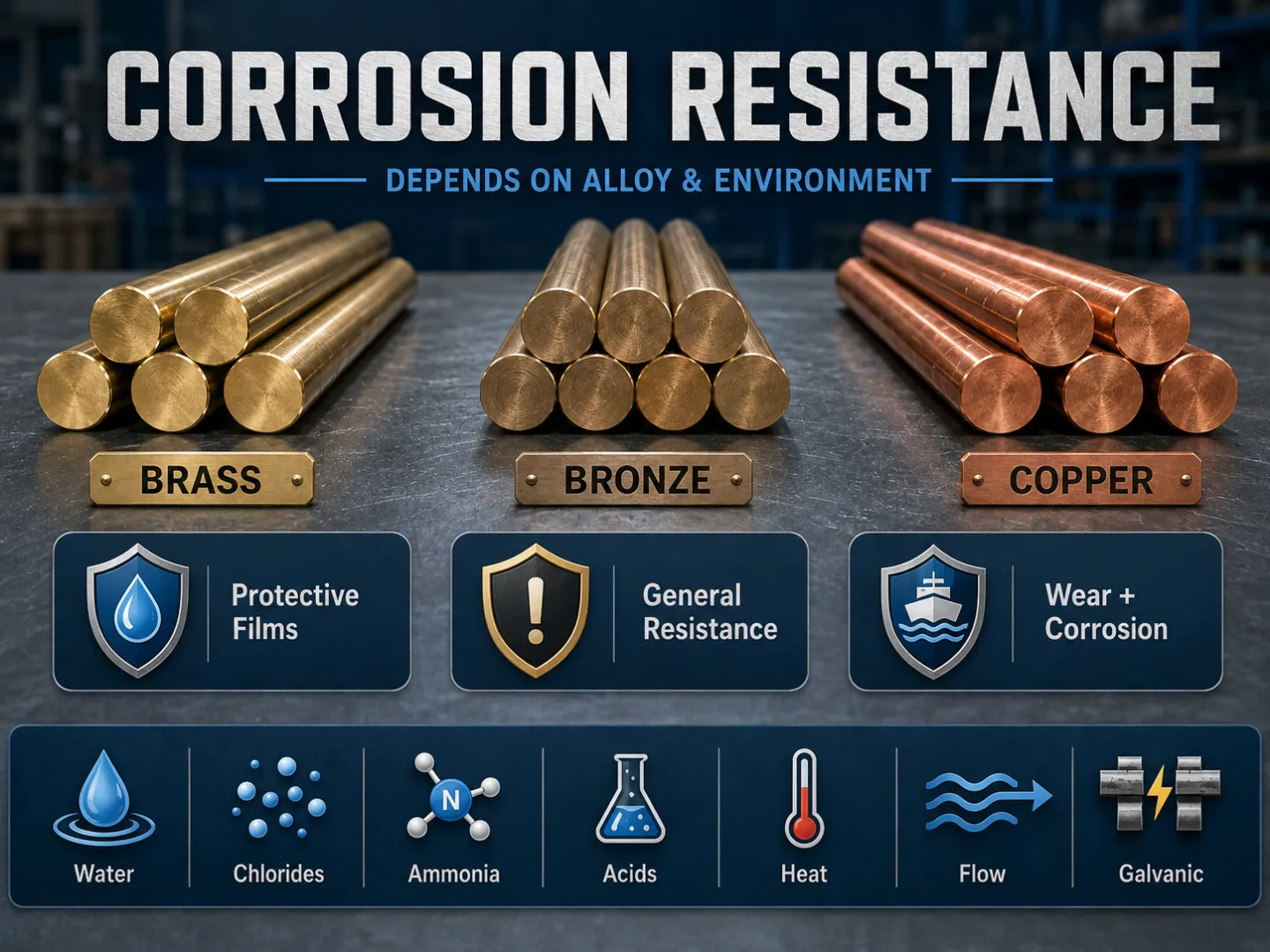
No single family wins every corrosion environment. Copper develops protective films in many atmospheric and water services. Brass provides good general resistance, but susceptible grades can experience dezincification, which removes zinc and leaves a weak, porous copper-rich structure. High-zinc brasses may also face stress-corrosion cracking.
Bronze often leads where corrosion acts with wear or load. C63000 aluminum bronze is identified for salt-water, cavitation, erosion, and pitting resistance in CDA application data. Tin bronzes resist many industrial environments, while naval brass C46500 is associated with salt-water and dezincification resistance.
Still define the water chemistry, chlorides, ammonia, sulfides, acids, temperature, flow, deposits, stress, and contact with dissimilar metals. A grade that survives still water may fail under high flow, crevices, or galvanic coupling.
Brass vs Bronze vs Copper: Practical Comparison
| Performance factor | Copper round bar | Brass round bar | Bronze round bar |
|---|---|---|---|
| Electrical conductivity | Highest; C11000 is about 101% IACS | Moderate to low; C36000 is about 26% IACS | Usually lower; C51000 is about 15% IACS |
| Thermal conductivity | Highest for heat transfer | Below copper but useful in many components | Usually below copper and common brasses |
| Sliding and wear | Not the first choice for loaded bearings | Suitable for light wear and machined hardware | Bearing grades offer low friction, wear resistance, and anti-seizing behavior |
| Corrosion behavior | Strong in many atmospheres and waters; environment still matters | Good general resistance; check dezincification and stress-corrosion risk | Grade-specific options for seawater, cavitation, wear, and industrial chemicals |
| Typical selection driver | Electrical or thermal transfer | Machinability, detail, and balanced properties | Bearings, bushings, gears, marine hardware, and wear-loaded parts |
These room-temperature examples do not replace the material specification, test report, design code, or application review.
How Should Engineers Select the Right Round Bar?
Use a function-led sequence before comparing price or availability:
- Identify the controlling duty. Rank electrical or thermal transfer, sliding wear, structural load, corrosion, and machining time.
- Define the operating system. State the mating material, lubrication, pressure, speed, temperature, chemicals, flow, and galvanic contacts.
- Compare exact UNS grades. Verify conductivity, strength, hardness, wear and corrosion data, temper, and governing standard.
- Specify the finished bar. State diameter tolerance, straightness, length, finish, stock allowance, inspection, and certification.
Precision or centerless grinding can improve diameter control, straightness, roundness, and finish. It does not change conductivity or corrosion resistance. Review Forte’s precision-ground round bar range alongside the finished-part drawing.
Final Verdict: Copper, Brass, or Bronze Round Bar?
Choose copper when conductivity dominates, a bearing bronze when friction and wear dominate, and a compatible bronze or specialized brass when corrosion acts with load or flow. Choose brass when high machinability and balanced performance offer the lowest practical manufacturing cost.
The final choice must name the grade because C110 copper, C360 brass, C932 bearing bronze, and C630 aluminum bronze solve different problems. To discuss material availability, grinding allowance, tolerance, finish, and certification, request a quote from Forte Precision Metals.
Frequently Asked Questions
Is Brass or Bronze More Electrically Conductive?
It depends on the grades. C360 brass is about 26% IACS, while C510 phosphor bronze is about 15% IACS. Copper remains substantially more conductive than either example.
Is Bronze Naturally Self-Lubricating?
Not every bronze is self-lubricating. Bearing bronzes may offer low friction or anti-seizing behavior, but the design can still require lubricant, correct clearance, and a suitable mating shaft.
Which Copper Alloy Is Best for Seawater?
There is no universal best grade. Selected aluminum bronzes resist salt water, cavitation, and erosion in marine hardware, shafts, propellers, and valves. Naval brass may also fit after reviewing dezincification, stress, and flow.
Does C360 Brass Resist Corrosion?
C360 offers useful general corrosion resistance and excellent machinability, but not for every environment. Review dezincification, stress-corrosion cracking, lead restrictions, temperature, and exposure chemistry.
Can Brass, Bronze, and Copper Round Bars Be Precision Ground?
Yes, when grade, temper, diameter, straightness, stock allowance, and finish support the process. Softer copper and different bronze or brass grades require different machining and grinding controls.