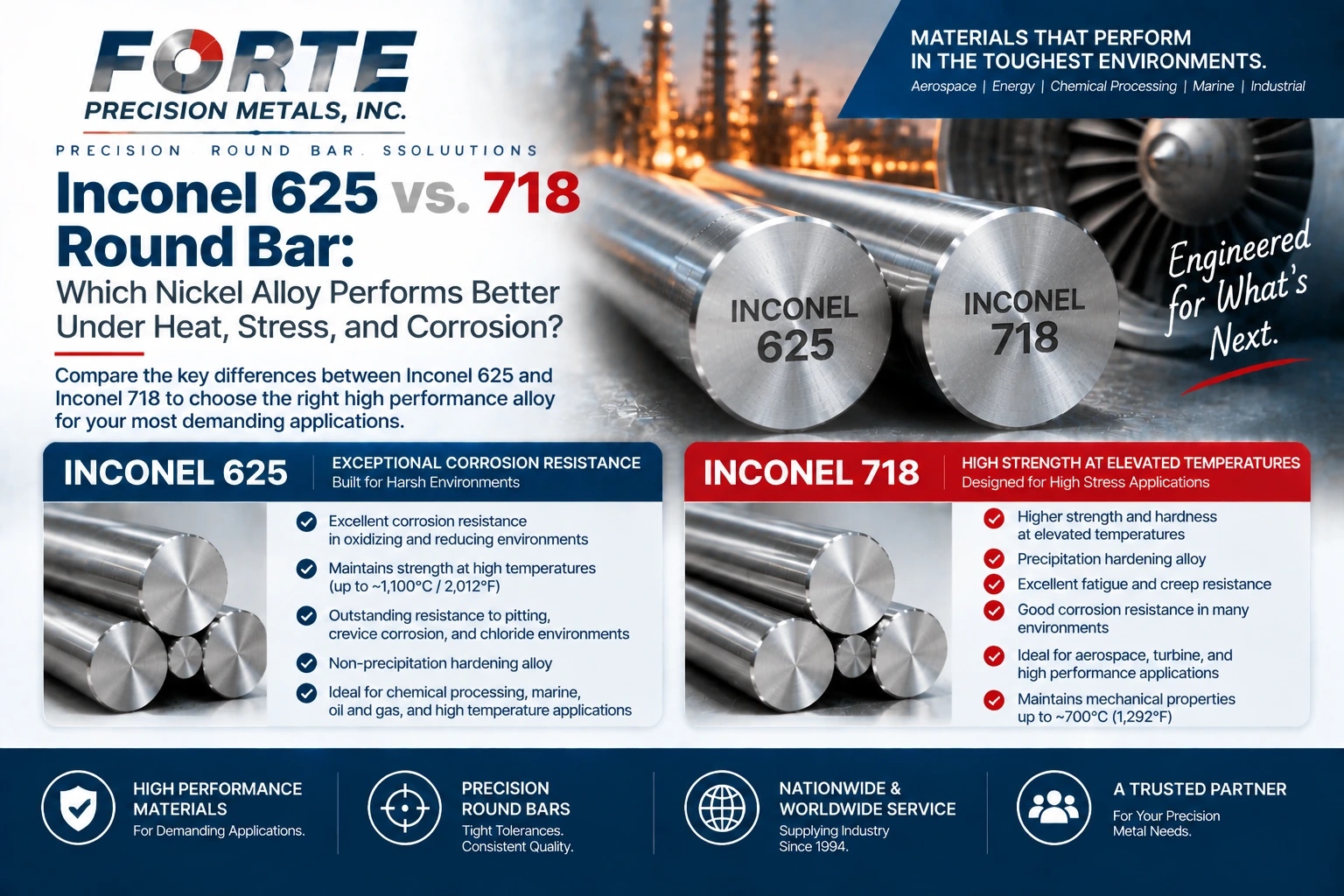
The Inconel 625 vs. Inconel 718 round bar choice depends on which demand dominates the application. We generally look to Inconel 625 when corrosion resistance, acid exposure, seawater service, and fabrication are central. We look to Inconel 718 when high mechanical strength, fatigue duty, creep resistance, and sustained elevated-temperature loading are more important. Temperature alone does not decide the grade.
At Forte Precision Metals, we supply nickel and high-temperature alloy round bar and support precision processing requirements. Because these alloys are costly to machine and difficult to replace after production begins, the RFQ should define grade, condition, diameter, length, finish, tolerance, documentation, and service environment before material is released.
How the Two Inconel Grades Develop Performance
Both alloys belong to the nickel-chromium family, but they obtain strength in different ways. That distinction shapes corrosion behavior, heat-treatment needs, weldability, and the loads each grade is expected to carry.
Inconel 625 Uses Solid-Solution Strengthening
Inconel 625 relies heavily on nickel, chromium, molybdenum, and niobium for its combination of strength and corrosion resistance. It does not depend on the same precipitation-hardening route as 718. Inconel 625 is an acid resistant nickel alloy with good weldability. It is commonly associated with applications such as aerospace ducting, jet engine exhaust systems, seawater equipment, thrust reversers, and chemical process equipment.
Why 625 Fits Aggressive Environments
Molybdenum and niobium contribute to strength, while the alloy system supports resistance across many corrosive conditions. For a component exposed to seawater, chemical media, or a combination of heat and corrosion, 625 may provide the more relevant balance. The exact medium, concentration, temperature, and stress state still require engineering review.
Inconel 718 Uses Precipitation Hardening
Inconel 718 uses gamma double prime strengthening and provides good weldability. A controlled heat-treatment cycle develops its high strength. The page connects 718 with nuclear reactors, aerospace, chemical processing, pollution-control equipment, gas-turbine parts, and liquid-fuel rocket-motor components.
Heat and Stress Do Not Point to the Same Winner
A high-temperature application may be controlled by oxidation, corrosion, tensile load, fatigue, creep, or stress rupture. The designer must identify the actual failure risk before comparing temperature capability.
Choose 718 When Load-Carrying Strength Leads
718 is often preferred for highly stressed parts that must retain strength at elevated temperatures. Rotating components, fasteners, turbine hardware, and aerospace parts may place high static and cyclic demands on the alloy. Its precipitation-hardening response allows the required strength to be developed through a specified thermal cycle.
Choose 625 When Corrosion and Fabrication Lead
625 is often favored for ducting, bellows, chemical equipment, seawater hardware, and welded fabrications where corrosion resistance and practical joining are decisive. It still offers useful strength, but its main advantage in this comparison is the broad balance of environmental resistance and fabrication rather than the maximum precipitation-hardened strength associated with 718.
Mixed Environments Require a Full Service Description
If a component sees heat, tensile stress, salt, acids, pressure cycles, and welding, no single property can decide the material. The RFQ or engineering review should identify operating and excursion temperatures, chemical exposure, load mode, pressure, expected life, joining method, and applicable material specification.
Corrosion Resistance and Oxidation Behavior
Both alloys resist oxidation and corrosion better than many conventional steels, but their relative advantage changes with the medium and condition.
625 for Seawater and Chemical Exposure
Inconel 625 is commonly selected for specialized seawater equipment and chemical process equipment where corrosion resistance is important. That makes it a logical candidate when chloride exposure or aggressive chemistry dominates. Suitability must still be confirmed against the actual process fluid, concentration, temperature, crevice condition, and fabrication route.
718 for Strength with Environmental Resistance
718 also provides corrosion and oxidation resistance, but it is commonly chosen because it combines that resistance with high strength after heat treatment. In gas-turbine or aerospace hardware, the design may accept 718 because the component must carry substantial load while operating in a hot environment.
Machining and Heat-Treatment Planning
Both grades can work harden and generate heat during cutting. A controlled plan for stock allowance, tooling, feeds, speeds, coolant, and final finishing is therefore important.
Machining Inconel 625
625’s work-hardening behavior rewards rigid setups, sharp tooling, and continuous cutting. The starting diameter should provide enough material for cleanup without creating excessive removal. Surface finish and straightness requirements should be stated if they affect chucking, turning, or final grinding.
Machining Inconel 718
718 adds the complexity of supplied condition and precipitation hardening. The production route must determine whether major machining occurs before aging and what allowance remains for final dimensions. Hardness, heat-treatment certification, and final inspection should be tied to the drawing.
How to Specify Inconel Round Bar
State whether the requirement is 625 or 718, then identify the governing specification, condition, heat treatment, diameter, length, quantity, tolerance, straightness, surface finish, testing, and certification. Our nickel and high-temperature alloy category provides the parent product context, but the purchase document must control the exact grade.
Our Selection Summary
Select Inconel 625 when aggressive corrosion, seawater, acids, weldability, and fabrication dominate. Select Inconel 718 when high strength, fatigue loading, and elevated-temperature load carrying dominate. For mixed service, compare the full environment and mechanical requirement rather than relying on a generic high-temperature label.
Request Nickel Alloy Round Bar
At Forte Precision Metals, we can review your grade, condition, dimensional, finish, and processing requirements. Send the complete specification and quantity through our Request a Quote form so we can evaluate the correct Inconel round bar for the job.
Frequently Asked Questions
Which alloy has higher strength?
Inconel 718 is generally selected for higher mechanical strength after precipitation hardening. Actual values depend on condition, heat treatment, section size, and governing specification.
Which alloy is better for seawater?
Inconel 625 is widely considered for seawater equipment because corrosion resistance is a central strength. The exact seawater conditions and component design still require review.
Can both grades be welded?
Yes. Both alloys are recognized for good weldability, but welding procedure, filler selection, section size, restraint, and post weld requirements must match the specification.
Does Inconel 718 require heat treatment?
Its high-strength capability is developed through a controlled precipitation-hardening cycle. The RFQ should state the required supplied condition and heat treatment.
Which grade is easier to machine?
Both are demanding compared with common steels. Condition, hardness, geometry, setup, and tooling determine the practical difference for a specific part.
What belongs in an Inconel round-bar RFQ?
Include alloy, specification, condition, diameter, length, quantity, tolerance, straightness, finish, heat treatment, testing, certification, and service context.