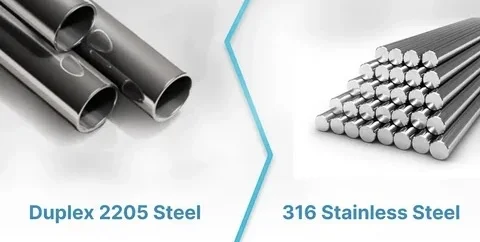
Both grades handle corrosion well, and both sit in our stainless steel round bar inventory at Forte Precision Metals. Engineers and buyers ask us to compare them regularly, and the confusion is understandable.
Picking the wrong grade creates real downstream problems. Understanding what separates these two materials helps you specify them correctly the first time and avoid costly redesigns later.
Two Grades Built for Different Demands
Duplex and 316 are not interchangeable, even though both perform in corrosion-resistant applications. The structural difference between them drives every practical trade-off you will face at the design or purchasing stage.
Each grade has a clear strength, and knowing that strength helps you match the material to your actual operating conditions. The sections below walk through the comparisons that matter most to engineers and procurement teams.
What 316 Stainless Steel Round Bar Does Best
316 is an austenitic, non-magnetic stainless steel with molybdenum added for corrosion resistance. That addition puts it ahead of 304 and makes it the default choice for pharmaceutical, marine, and medical applications.
Forte Precision Metals also stocks 316/316L, the extra low carbon version suited for welded assemblies, and 316LVM for medical and biochemical applications with stricter cleanliness requirements. For most corrosion-resistant bar work, 316 is proven, widely available, and machines cleanly through our centerless grinding process.
Where Duplex Stainless Steel Has the Advantage
Duplex is an austenitic-ferritic grade with a two-phase microstructure. That structure gives it higher strength than standard austenitic grades and strong resistance to stress corrosion cracking in chloride environments under load.
Duplex is also magnetic, which differs from the non-magnetic character of 316. For marine, chemical processing, offshore equipment, and desalination applications where chloride exposure combines with mechanical stress, duplex is the grade that holds up where standard austenitic grades can fall short.
How Corrosion Resistance Compares
316 carries the best corrosion resistance designation within the standard austenitic family. For pharmaceuticals, food processing, reactor vessels, marine hardware, and medical implants, it performs reliably and remains the industry default.
Duplex steps in when the environment combines chloride exposure with mechanical stress, a condition where austenitic grades can be more vulnerable to cracking failures. If your 316 parts are holding up without issue, there is no reason to switch grades.
Strength, Machinability, and Processing
Duplex has higher strength than standard austenitic grades, which can allow a smaller cross-section for the same load requirement. That structural advantage matters when weight or space is constrained in your design.
316 runs more smoothly through machining operations. Duplex work hardens more aggressively, so your team will need to adjust feeds, speeds, and tooling. Both grades move through our centerless grinding operation, which handles bars up to 7 inches in diameter and up to 24 feet in length.
Finishing and Companion Services Forte Precision Metals Offers
After grinding, both grades can move directly into our polishing service, which goes up to a number 8 mirror finish. We also offer chamfering for clean beveled ends, bar straightening for dimensional accuracy, and saw cutting for cut-to-length requirements.
All of these services run in-house at our Franklin Park facility under our ISO 9001:2015 quality system. That means your bar does not leave our floor between processing steps, and every order goes out under one consistent quality standard.
Get the Right Grade Shipped to Your Floor
Not sure whether duplex or 316 fits your application? Our team is available Monday through Saturday, 7 AM to 5 PM, to talk through your specification before you commit.
Call us at +1 (847) 451-8888 or submit your bar requirements directly at fortemetals.com/request-a-quote. We ship nationally and worldwide, and every order ships under our ISO 9001:2015 certified quality system.
Frequently Asked Questions
Is 316 stainless steel magnetic?
No. 316 is austenitic and non-magnetic. Duplex is magnetic because its two-phase microstructure includes a ferritic phase.
Should I switch from 316 to duplex for marine parts?
Only if parts face sustained stress in a chloride environment, if your 316 components are performing reliably, stay with that grade.
Do you stock both duplex and 316 round bar?
Yes. Both are in our stainless inventory. We also stock 316/316L and 316LVM. Contact us with the diameter and length to confirm availability.
Can you grind both grades to tight tolerances?
Yes. Our centerless grinding handles both duplex and 316, up to 7 inches in diameter and 24 feet in length.