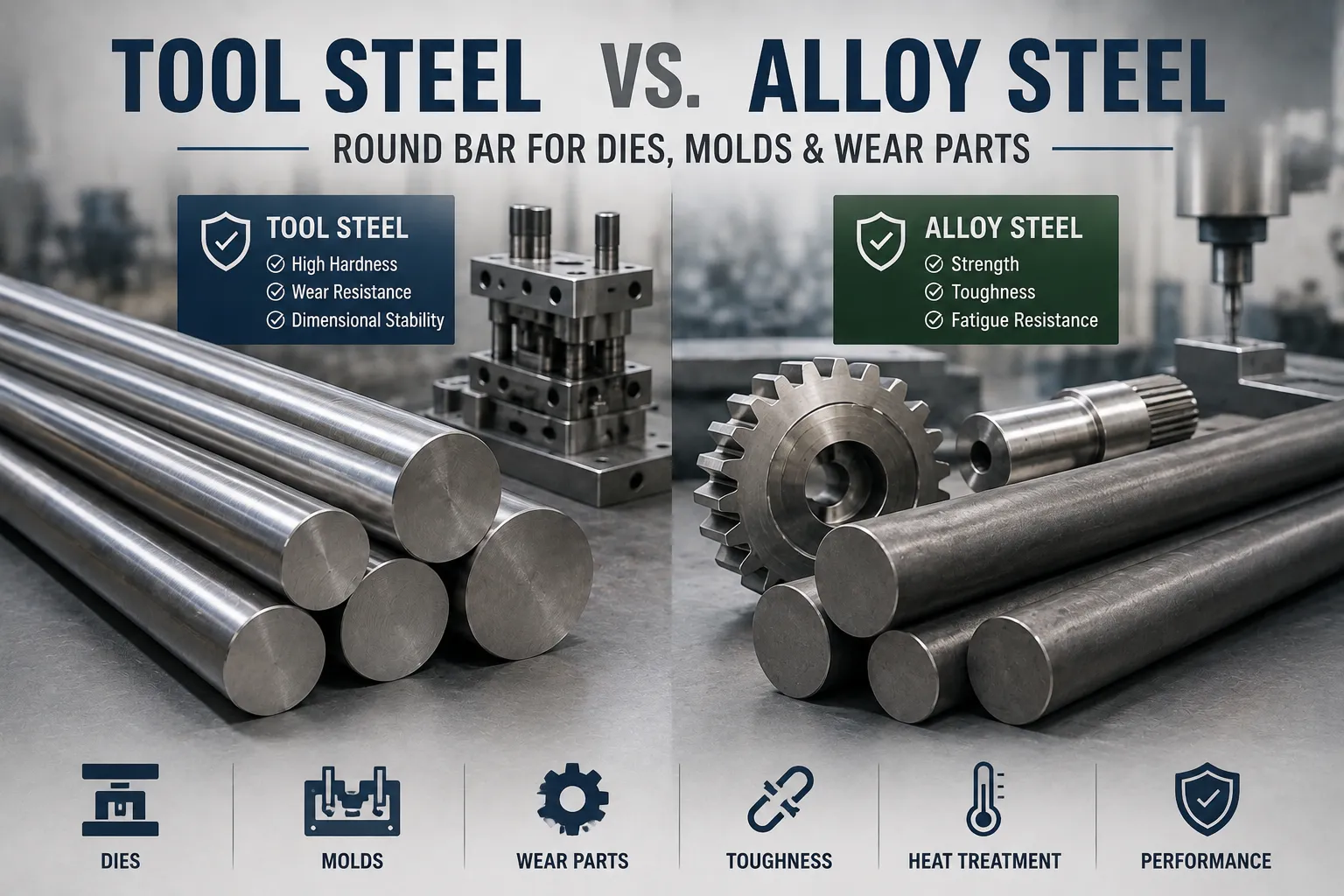
Choosing tool steel vs alloy steel round bar depends on what the finished component actually has to do. For dies, molds, punches, and tooling surfaces exposed to repeated wear, tool steel is often the more direct material family because specific tool steel grades are designed around hardness, wear resistance, dimensional stability, and tooling applications. Alloy steel, however, can be the better fit for highly stressed wear parts, die holders, shafts, fixtures, and components where toughness, strength, fatigue performance, or a particular heat-treatment response carries more weight.
At Forte Precision Metals, we supply both tool steel and alloy steel round bar, so the decision should start with the application rather than with the material-family name alone. The grade, condition, wear mechanism, loading, temperature, and dimensional requirements all affect which bar stock should be specified.
How Tool Steel and Alloy Steel Round Bar Differ for Dies, Molds, and Wear Parts
Start With What the Component Must Do
Tool steel is a classification of steels used primarily for tooling applications. Forte’s tool steel material information emphasizes hardness, abrasion resistance, wear resistance, and resistance to deformation. Our listed applications include machine tools, cutting tools, tooling blocks, dies used for casting, molding and stamping, wear plates, drill bits, and end mills.
Alloy steel round bar covers a much broader group of grades. Their properties vary according to composition and grade, and Forte lists alloy steel applications ranging from aircraft and automotive components to gears, shafts, fasteners, bearings, die holders, and components subjected to severe wear.
This difference is important. A die face and a die holder may be part of the same assembly, but they do not necessarily need the same material.
| Manufacturing Requirement | Tool Steel Examples | Alloy Steel Examples |
| Blanking and forming dies | D2, D3, D5 | Grade should be evaluated separately |
| Hot-work dies | H13, H21, H26 | Grade should be evaluated separately |
| Injection molds | P20 | Grade should be evaluated separately |
| Die holders | Tool grade depends on requirement | 4142 |
| High-wear components | D2, D3, wear-plate applications | 4140, 6150 |
| Highly stressed parts | Grade-specific | 4140, 4340, 52100 and others depending on application |
The correct comparison therefore is not simply “tool steel is harder” or “alloy steel is tougher.” It is which specific grade provides the required attributes for the working conditions of the component.
Why Tool Steel Is Often the Better Starting Point for Dies
Dies create an especially strong case for looking at tool steel round bar first because several tool steel grades on Forte’s material table are specifically associated with die applications.
D2 is a high-carbon, high-chromium tool steel described by Forte as highly wear resistant and deep hardening. Its listed applications include thread-rolling dies and blanking and forming dies. D3 is also listed for draw dies and blanking and forming dies, while A10 is associated with thread-rolling dies and intricate die shapes.
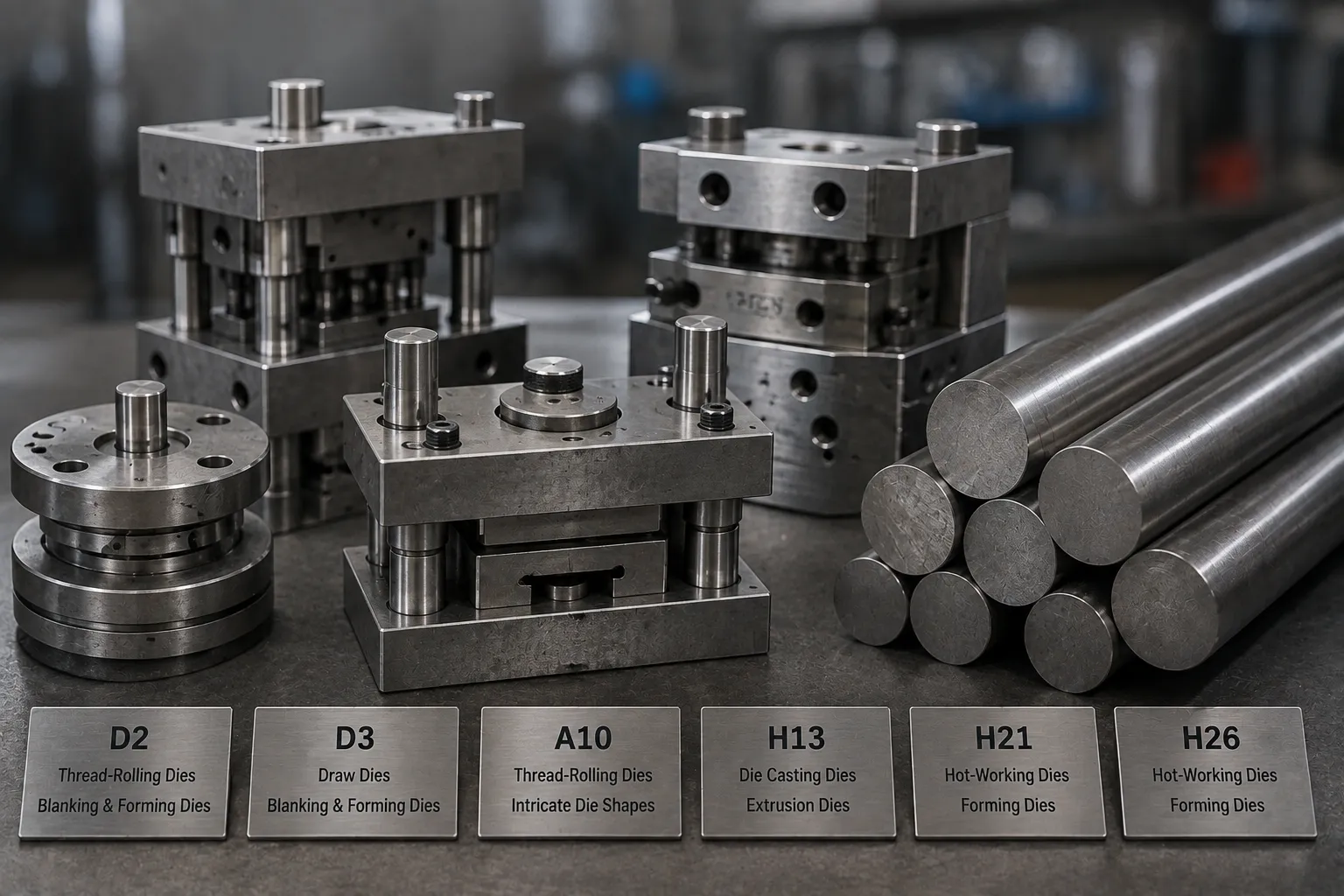
Hot-working conditions introduce a different requirement. Forte lists H13 for die casting, die work, and extrusion dies, while H21 and H26 are also associated with hot-working and forming-die applications. That illustrates why “tool steel” alone is still not a complete specification. The grade must match the type of die operation.
For high-volume blanking and forming applications specifically, Forte also identifies D2 around its high-carbon, high-chromium composition, deep-hardening behavior, and abrasion resistance.
What About Steel for Molds?
Mold applications again point toward a grade-specific tool steel decision.
Forte identifies P20 as a mold steel and lists injection molds and die-casting dies among its applications. This makes P20 a more direct candidate when the requirement is specifically a mold rather than simply a highly loaded machine component.
The important sourcing lesson is to avoid specifying generic “tool steel round bar” on the basis that all tool steels behave alike. D2 is associated with high wear and blanking/forming dies, H13 with hot-work applications, and P20 with molds. Each occupies a different application context.
When we review material requirements, the grade therefore matters as much as the broader material family.
When Alloy Steel Makes More Sense
There are applications near the tooling process where alloy steel round bar may provide the more appropriate combination of properties.
For example, Forte lists 4142 alloy steel for die holders along with forged gears, collets, spindles, arbors, flanges, axles, and clutch components. A die holder supports the tooling system, but its job is different from the cutting or forming surface of a die.
4140 is another useful example. Forte describes 4140 as having good hardness penetration, wear resistance, toughness, and ductility and identifies it for highly stressed components and parts subjected to severe wear.
Other alloy grades shift the decision again. Forte associates 4340 with high toughness and fatigue strength, while 6150 is identified as highly abrasion resistant. This shows why some wear parts should not automatically be specified as tool steel. If the component’s dominant requirement involves loading, fatigue, toughness, or a particular wear condition, an alloy steel grade may fit the application better.
Wear Resistance Alone Does Not Decide the Material
The phrase wear part covers many different components.
A blanking die experiences a different service condition from a wear plate, gear shaft, bearing component, die holder, or machine fixture. Selecting only for “wear resistance” can therefore oversimplify the decision.
Tool steel is strongly represented in Forte’s product range for dies, molds, punches, cutting tools, and wear plates. Alloy steel includes grades intended for severe-wear parts, gears, shafts, bearings, fasteners, and highly stressed components.
The more useful questions are:
- Is the component itself performing the cutting, forming, or molding operation?
- Is abrasion the dominant concern?
- Does the component carry substantial mechanical load?
- Is toughness particularly important?
- Will the part operate at elevated temperature?
- Is dimensional stability important to the tooling operation?
- What heat-treated condition does the print require?
- What final diameter, tolerance, straightness, and surface finish are required?
Those questions narrow the material family before the exact grade is selected.
Do Not Separate Material Selection From Heat Treatment
Both families must also be considered in relation to their required condition.
Forte describes tool steel as developing its hard properties through heat-treated conditions, and individual tool steel grades differ in hardening behavior and resistance to softening. The alloy steel page similarly notes that alloy grades can be quenched and tempered to achieve particular combinations of strength and toughness.
That means an RFQ should not stop at “D2,” “4140,” or another grade name when the engineering requirement calls for a particular material condition.
The material specification, heat-treatment requirement, and final dimensional requirement need to agree with one another.
Why Ground Bar Condition Matters for Tooling Components
Once the material and grade are selected, the starting geometry of the bar can affect the next manufacturing operation.
Forte provides precision and centerless ground bar forms for tool and alloy steels. For its centerless grinding operation, Forte publishes processing capability up to 7 inches in diameter and 24 feet in length, with dimensional tolerances as tight as ±0.0001 inch and finishes down to 8 RA. These figures describe Forte’s published centerless grinding capability and should be confirmed against the specific material and job requirement.
For a die, mold component, shaft, tooling insert, or wear component that will undergo additional machining, starting with the required diameter, straightness, surface condition, and processing sequence can help keep the incoming bar aligned with the print requirements.
What Should You Put on an RFQ?
When requesting tool steel or alloy steel round bar, give the supplier enough information to distinguish the material requirement from the processing requirement.
Include, where applicable:
- Material family
- Exact grade
- Required material condition
- Bar diameter
- Bar length
- Diameter tolerance
- Straightness requirement
- Required surface finish
- Quantity
- Cut-to-length requirements
- Chamfering requirements
- Grinding requirements
- Additional machining requirements
- Finished-component application
Forte provides centerless grinding along with services including chamfering, cutting, straightening, machining, milling, turning, polishing, and material packaging. The exact processing capability should be matched to the individual RFQ rather than assumed from the material grade alone.
So, Is Tool Steel or Alloy Steel Better?
For the working surfaces of dies, molds, punches, and similar tooling, tool steel is generally the more direct material family to evaluate because Forte lists multiple grades specifically engineered around those applications.
For die holders, heavily loaded wear parts, shafts, gears, fixtures, and other stressed components, an alloy steel grade may provide a more appropriate combination of toughness, strength, fatigue performance, and wear resistance.
The final answer therefore comes down to the specific grade and operating requirement, not the family name alone.
At Forte Precision Metals, we supply precision ground tool steel and alloy steel round bar and provide in-house bar processing for manufacturing requirements. If your print specifies a grade, diameter, condition, tolerance, finish, or secondary operation, submit those requirements through our Request a Quote form so we can review the material and processing requirements for the job.
FAQs
Is tool steel better than alloy steel for dies?
Tool steel is generally the more direct starting point for die applications because Forte specifically lists grades including D2, D3, D5, A10, H13, H21, and H26 for different die and hot-work applications. The exact grade should match the die’s operating conditions.
Which tool steel does Forte list for injection molds?
Forte identifies P20 as mold steel and lists injection molds and die-casting dies among its applications.
Can alloy steel be used for wear parts?
Yes. Forte lists 4140 for highly stressed components or parts subjected to severe wear and describes 6150 as highly abrasion resistant. The correct grade depends on the type of wear and the other mechanical requirements.
What alloy steel does Forte list for die holders?
Forte lists 4142 alloy steel for die holders, forged gears, collets, spindles, arbors, flanges, axles, and clutch components.
Can Forte supply precision ground tool steel and alloy steel bar?
Yes. Forte supplies both material families and provides precision and centerless grinding along with additional bar-processing services.