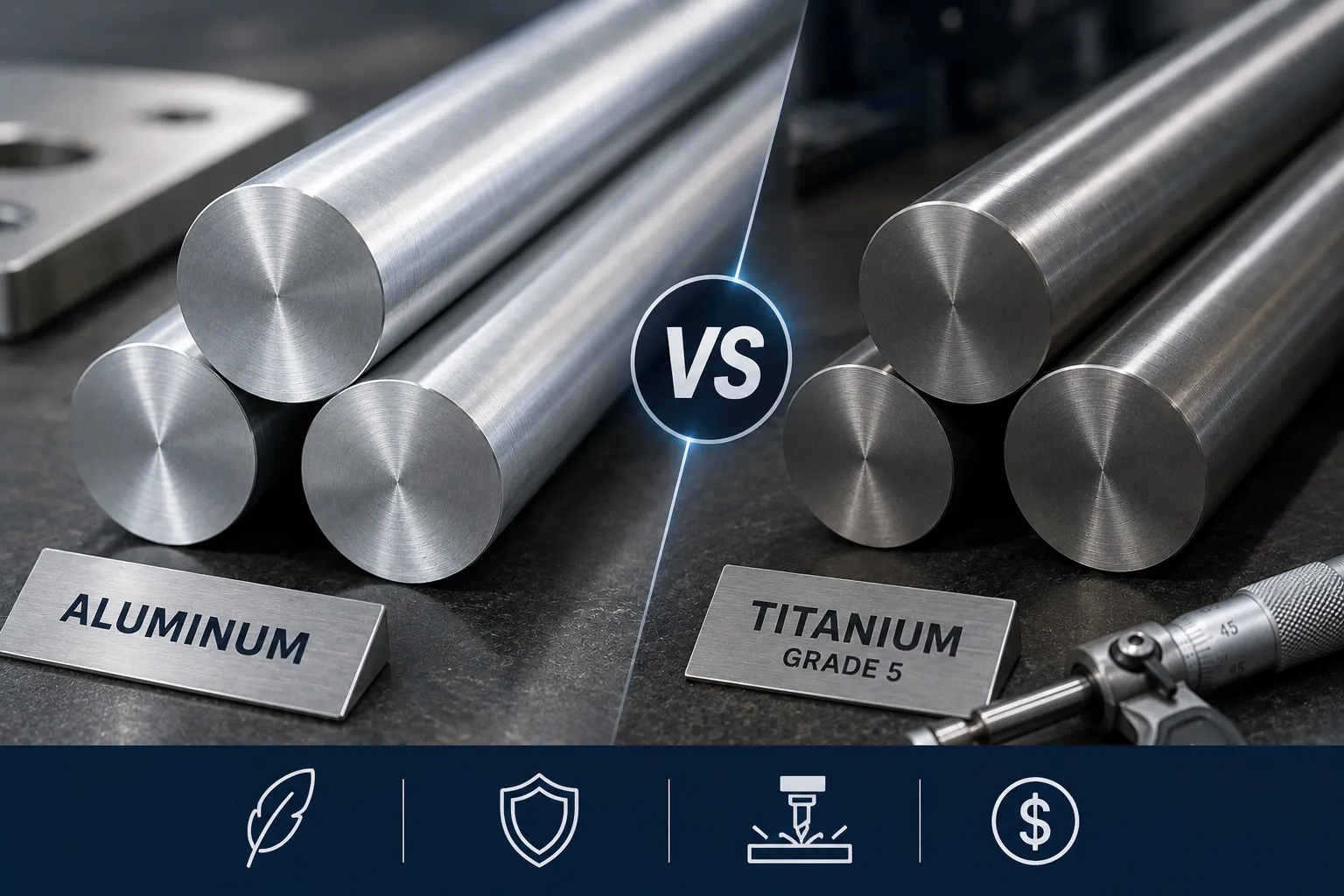
The aluminum vs titanium round bar comparison often comes down to strength-to-weight performance and total manufacturing requirements. Grade 5 titanium round bar generally offers a better strength-to-weight ratio than 6061 aluminum and a slight advantage over many 7075-T6 round-bar conditions. However, aluminum is significantly lighter at the same diameter, easier to machine, and typically more economical. The better choice depends on the exact alloy, temper, design load, available space, operating temperature, corrosion exposure, and total finished-part cost.
What Does Strength-to-Weight Ratio Mean for Round Bar?
Strength-to-weight ratio, or specific strength, divides strength by density. Use yield strength when permanent bending controls; ultimate strength describes the point near fracture.
The calculation must use a named grade and condition. 6061-T6, 7075-T6, Grade 2 titanium, and Ti-6Al-4V Grade 5 have different properties. Forte Precision Metals supplies aluminum round bar and titanium round bar, but the designation must match the drawing and service conditions.
Which Material Has the Higher Specific Strength?
Grade 5 titanium normally leads this comparison, but high-strength 7075 aluminum is close. Published minimum properties for extruded bar show why grade-level comparison matters.
| Material and condition | Density (g/cm³) | Room-temperature UTS | UTS-to-density index |
|---|---|---|---|
| 6061-T6/T6511 aluminum | 2.70 | 262 MPa minimum | 97 |
| 7075-T6/T6511 aluminum | About 2.81 | 538–558 MPa minimum* | 191–199 |
| Grade 5 Ti-6Al-4V titanium | 4.42 | 895 MPa minimum | 202 |
Sources: Aluminum Association bar limits and the TIMET Ti-6Al-4V data sheet. Values vary by specification, size, and temper. *The 7075 range depends on bar size.
Why Does Titanium Win If Aluminum Is Lighter?
Aluminum has the lower density. A Grade 5 titanium bar of the same diameter and length weighs about 64 percent more than a 6061 aluminum bar. Titanium wins because its strength increases by a greater proportion than its weight. This may permit a smaller titanium section; if diameter is fixed, aluminum remains lighter.
How Do 6061 and 7075 Change the Answer?
6061 aluminum round bar balances strength, corrosion resistance, machinability, and fabrication for structural, automation, marine, and industrial parts.
7075 aluminum round bar reaches much higher strength. It suits weight-sensitive parts, but can offer lower weldability and less forgiving corrosion behavior than 6061.
Does Strength-to-Weight Ratio Tell the Whole Story?
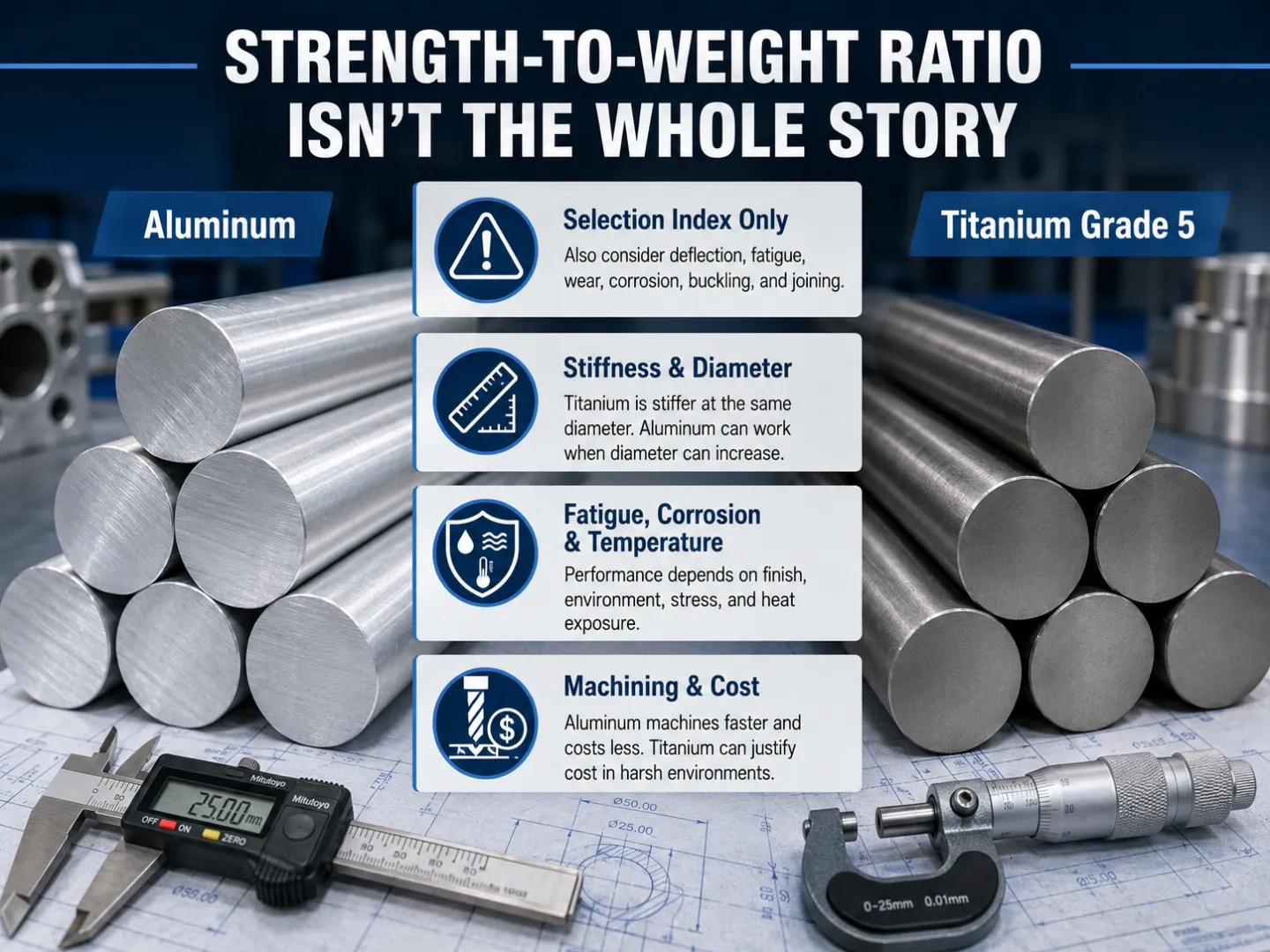
No. Specific strength is one selection index. A bar can meet a tensile calculation and still fail through deflection, fatigue, wear, corrosion, buckling, or unsuitable joining.
Stiffness and Available Diameter
Grade 5 titanium has a Young’s modulus of about 107–122 GPa; aluminum is commonly near 69 GPa. Titanium is stiffer at the same diameter, but their stiffness-to-density ratios are similar. Aluminum can work well when designers have room to increase diameter.
Fatigue, Corrosion, and Temperature
Fatigue depends on condition, finish, stress concentration, load, and environment. Titanium gains value in seawater, chlorides, and heat. TIMET reports Ti-6Al-4V retains reasonable properties to about 350°C (660°F) and resists general seawater corrosion. Review aluminum coatings, galvanic contact, and heat exposure.
Machining and Finished-Part Cost
Aluminum machines faster and causes less tool wear. Titanium’s low thermal conductivity and galling tendency require controlled speeds, sharp tools, rigid setups, and coolant. Titanium can justify its cost through smaller size or environmental durability; aluminum often wins on economy.
Which Round Bar Should You Choose for Your Application?
Choose Grade 5 titanium for maximum strength in limited space, corrosion, or higher temperatures. Choose 7075 aluminum for near-titanium specific strength with lower density and easier processing. Choose 6061 aluminum for balanced performance, fabrication, and cost.
Use this selection sequence before releasing a drawing:
- Define the governing load. Decide whether yield, ultimate strength, fatigue, buckling, impact, or deflection controls the design.
- Compare exact specifications. Confirm alloy, temper, product form, diameter range, heat treatment, and certified minimum properties.
- Add service constraints. Evaluate temperature, corrosion, galvanic contact, wear, joining, surface finish, and inspection requirements.
- Compare the finished part. Calculate required diameter and mass, then include machining time, tooling, coatings, scrap, and lifecycle cost.
Precision grinding controls diameter, roundness, straightness, and finish; it does not change density or certified strength. Review Forte’s precision-ground round bar product range and provide the drawing, specification, diameter, tolerance, quantity, and service environment.
Final Verdict: Aluminum or Titanium Round Bar?
Grade 5 titanium offers the better overall strength-to-weight ratio against common 6061 and 7075 aluminum bar conditions. Its advantage over 6061 is substantial, while its lead over 7075-T6 can be modest. Aluminum still weighs less at equal volume and may cost less to process.
Choose the grade that satisfies strength, stiffness, fatigue, environment, dimensions, and budget with the lowest finished-part risk. Request a quote from Forte Precision Metals to discuss material and precision-processing requirements.
Frequently Asked Questions
Is Titanium Lighter Than Aluminum?
No. Titanium is denser, so an equal-size titanium bar weighs more. Its higher strength may allow a smaller cross-section in a load-limited design.
Is 7075 Aluminum Stronger Than Grade 5 Titanium?
No under the representative specifications compared here. Grade 5 titanium also has a slightly higher tensile-strength-to-density index, although values depend on product form, diameter, heat treatment, and specification.
Is 6061 or Titanium Better for a Machined Shaft?
It depends on load, stiffness, contact, temperature, wear, and corrosion. 6061 is lighter by volume and easier to machine. Grade 5 supports higher stress in a smaller section but can gall.
Can Aluminum and Titanium Round Bars Both Be Precision Ground?
Yes. Both can receive controlled diameter and surface finish, but grinding parameters must suit the alloy. Confirm stock allowance, temper, tolerance, straightness, finish, and permitted defects.
Does a Higher Strength-to-Weight Ratio Guarantee Longer Fatigue Life?
No. Specific strength excludes fatigue behavior. Surface condition, notches, residual stress, corrosion, temperature, and load history may dominate, so use application-specific fatigue data and suitable safety factors.