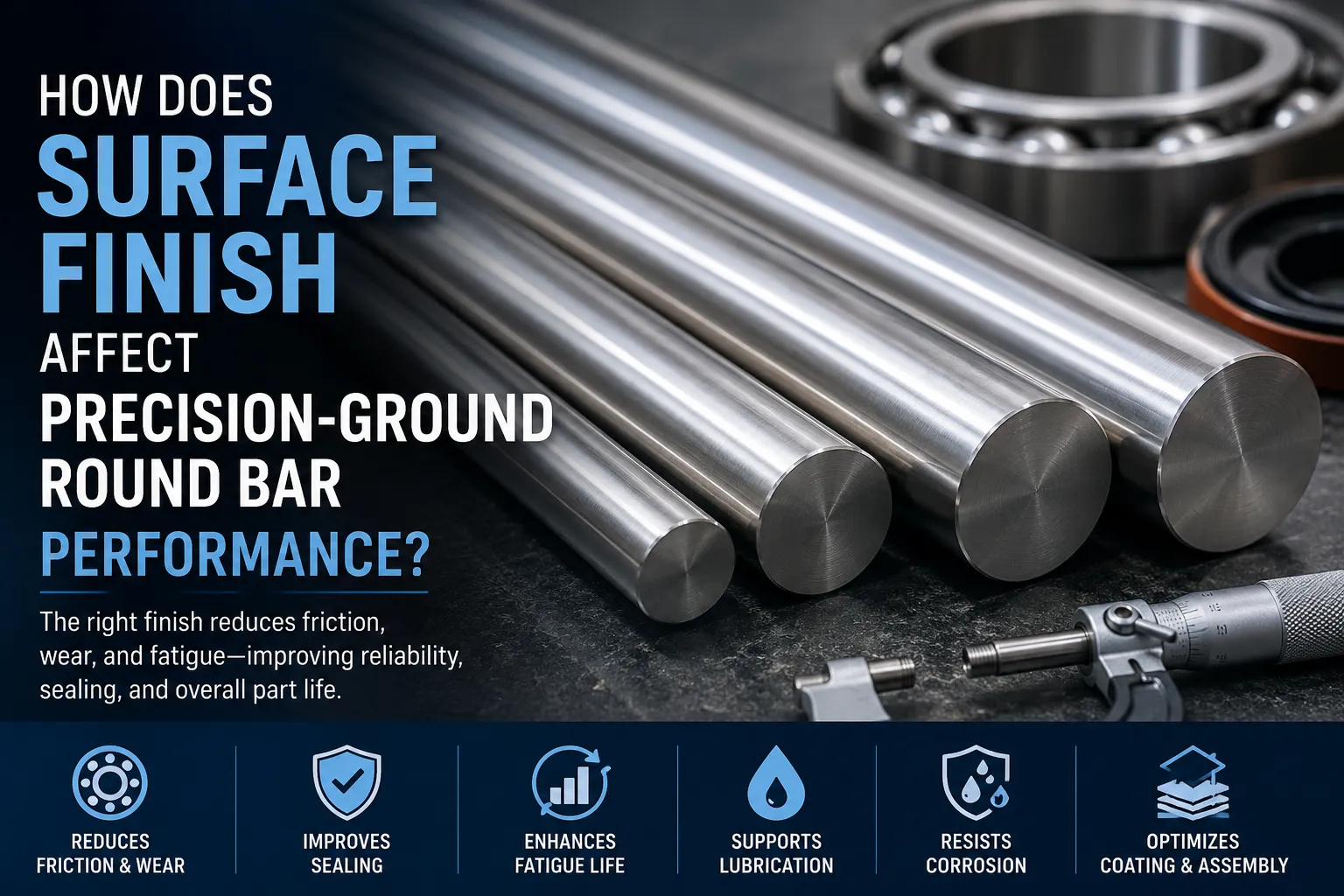
Surface finish affects how a precision-ground round bar contacts, moves against, seals, and bonds with other components. A controlled finish can stabilize friction, support lubrication and sealing, reduce wear and fatigue risk, and limit secondary work. The lowest roughness value is not always best; the correct finish depends on the material, load, motion, mating part, coating, and environment.
What Does Surface Finish Mean on a Precision-Ground Round Bar?
Surface finish describes the small geometric features left after grinding or polishing. ASME B46.1 separates surface texture into roughness, waviness, and lay: fine irregularities, wider-spaced variations, and the pattern’s predominant direction.
Ra, or arithmetic average roughness, is common on drawings but does not describe every peak, valley, scratch, or directional mark. “8 Ra” is incomplete without a unit; 8 microinches Ra is approximately 0.20 micrometer Ra. Ra and RMS/Rq are different.
Surface finish must be considered with diameter tolerance, roundness, straightness, hardness, and surface integrity. A smooth bar can still perform poorly if its geometry or material condition is wrong. Forte’s precision-ground round bar products span multiple material families, so finish must match the grade and application.
How Does Surface Finish Affect Friction, Wear, and Heat?
Real contact begins at microscopic high points called asperities. On a rough shaft, fewer asperities initially carry the load, increasing local pressure, abrasion, running-in wear, and friction variation. A controlled finish reduces extreme peaks and makes contact more consistent.
The relationship is not simply “smoother means less friction.” Under lubrication, valleys can retain fluid while texture direction influences its movement. The ideal finish balances smooth load-bearing areas with functional texture for the lubrication regime.
Why Does It Matter for Bearings and Seals?
For a bearing journal or sliding shaft, roughness affects the ratio between lubricant-film thickness and the combined roughness of the contacting surfaces. NASA research shows that inadequate film thickness relative to roughness can shorten rolling-contact life.
Seals are sensitive to the complete topography. Peaks may wear the lip, valleys may form leakage paths, and directional lay may pump fluid. A radial-lip-seal study found that profile shape and skewness correlated with leakage behavior. Forte’s bearing shaft quality bar shows why finish, straightness, diameter control, and material must work together.
Can Surface Finish Influence Fatigue Life?
Yes. Scratches, sharp valleys, and chatter marks can concentrate cyclic stress and start fatigue cracks. A consistent finish generally reduces these initiation sites in shafts, pins, axles, and other repeatedly loaded parts.
A low Ra does not prove good surface integrity. Grinding burn, microcracking, or harmful tensile residual stress can erase its benefit. Fatigue-critical bars need both texture and subsurface-condition control.
Does It Affect Corrosion Resistance and Cleanability?
A rough surface has more valleys where moisture, chloride, or residue can remain. In a study of 2205 duplex stainless steel, rougher surfaces showed more frequent pit initiation. Uniform surfaces can also be easier to clean.
Finish does not replace the correct alloy, passivation, coating, or maintenance. Corrosion still depends mainly on material chemistry and exposure conditions.
How Does It Affect Coatings, Machining, and Assembly?
A consistent ground surface can improve coating uniformity, reduce later stock removal, and let a bar enter machining or assembly with fewer preparatory operations.
Coating adhesion is process-specific. Some coatings need roughness for interlocking, while excessive roughness can create thin spots or harmful stresses. NIST research demonstrates this trade-off. Follow the coating supplier’s preparation requirements.
| Application | Performance concern | Finish details to prioritize |
|---|---|---|
| Bearings and sliding shafts | Friction, film separation, wear | Ra/Rq, waviness, lay, hardness |
| Radial seals | Leakage and lip wear | Peaks, valleys, skewness, lay |
| Fatigue-loaded parts | Crack initiation | Deep defects, Rz/Rt, surface integrity |
| Coated parts | Adhesion and uniformity | Required profile and cleanliness |
| Corrosive or hygienic service | Pitting and residue retention | Uniformity, cleanability, alloy condition |
Is a Lower Ra Value Always Better?
No. A lower Ra value is better only when it supports the component’s function. Fine finishing adds cost and may remove texture needed for lubrication or coating adhesion. Low Ra can also hide waviness, lay, scratches, or grinding damage. Specify the least costly finish that reliably meets the requirement.
How Should Engineers Specify Surface Finish?
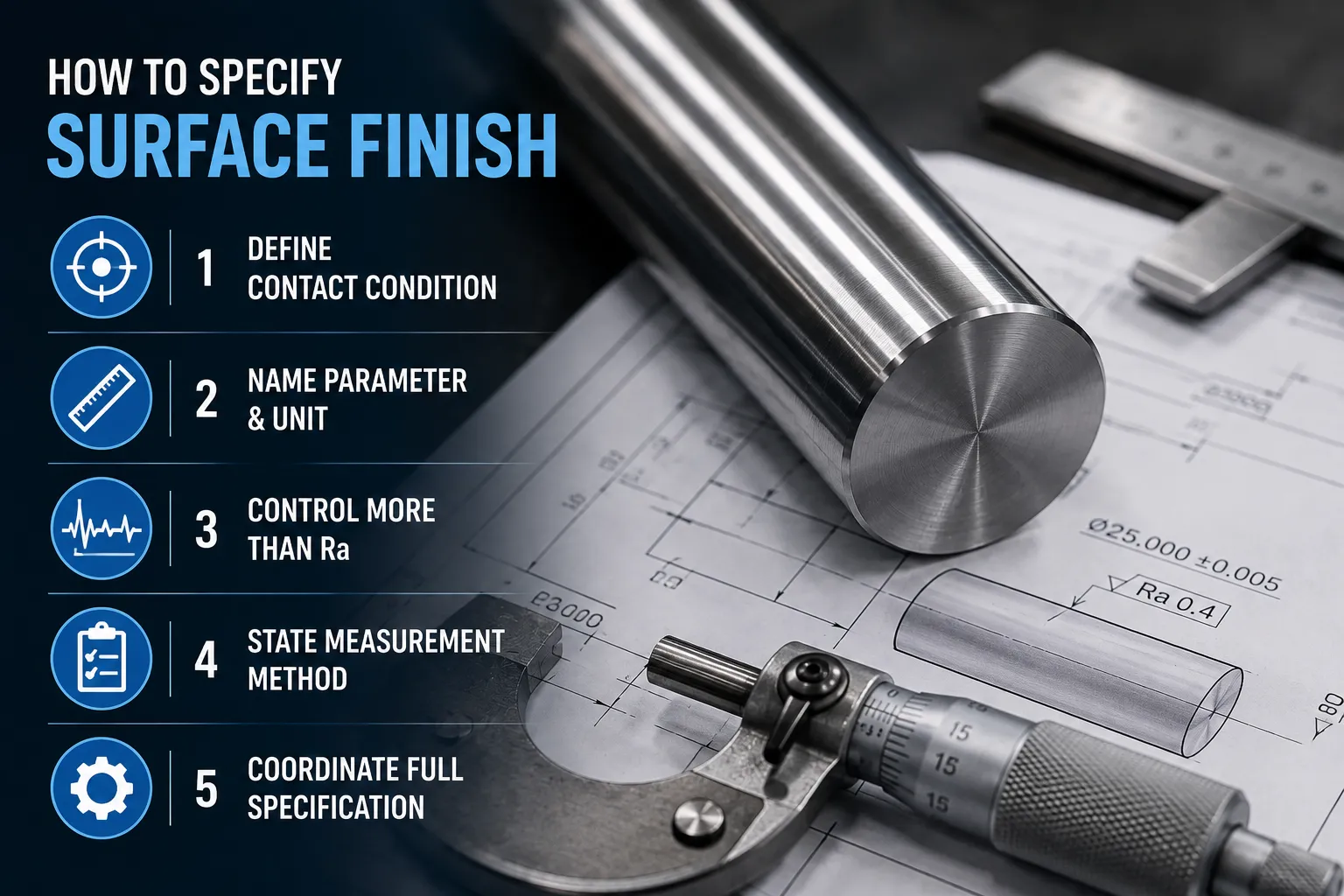
- Define the contact condition. State whether the bar will rotate, slide, seal, carry cyclic load, receive a coating, or face corrosion.
- Name the parameter and unit. State Ra, Rq, Rz, Rt, or another parameter, followed by microinches or micrometers and an acceptable limit.
- Control more than Ra when necessary. Add limits for waviness, lay, peak-and-valley behavior, or defects when they affect performance.
- State the measurement method. Reference ASME B46.1 or ISO 21920, with the cutoff, evaluation length, direction, and inspection location when applicable.
- Coordinate the full specification. Pair finish with diameter tolerance, roundness, straightness, hardness or heat treatment, grade, length, and permitted defects.
How Can Buyers Select the Right Ground-Bar Finish?
Buyers should provide the drawing, grade, final diameter, tolerance, contact type, lubrication, coating process, and environment. This helps the supplier recommend a functional finish without unnecessary cost.
Forte Precision Metals grinds bars up to 7 inches in diameter and 24 feet long, with tolerances as tight as plus or minus 0.0001 inch and finishes down to 8 Ra where required. Review its centerless grinding tolerances or request a quote.
Frequently Asked Questions
What Is Ra on a Precision-Ground Bar?
Ra is the arithmetic average height of a roughness profile. It supports general finish control but does not fully describe waviness, lay, defects, or peak-and-valley shape.
Is an 8 Ra Finish Good for Round Bar?
An 8 microinch Ra finish is fine, but it is suitable only when required by the drawing and application. Bearings, seals, and coatings may need different textures.
Can a Smooth Finish Compensate for Loose Diameter Tolerance?
No. Finish controls microscopic texture, while diameter tolerance controls size. Roundness, straightness, and hardness separately influence fit, motion, and service life.